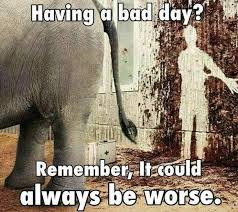
They’re starving in places all over the world – but the plight of thousands in Ethiopia was brought into stark relief across the globe during the 1983-85 famine by the worthy and incredible efforts of Bob Geldof and anyone whom he grabbed by the collar and ‘voluntold’ their services for the relief of suffering. Meanwhile, across Britain, schools did their part in raising awareness and funds to alleviate the suffering of over seven and a half million Ethiopians as for once, the West took notice.
I was ten years old when Live Aid aired in 1985 and I would wager that those of you reading this post of a similar age would have been, like me, the first generation to have been introduced, should you be whining or complaining about…well, anything really, to the a new and impenetrable comparison to whatever ailed you…”They’re starving in Africa you know”
It’s true of my experience and I bet it’s true of yours. There was no individual injustice, personal effrontery or keenly felt unfair result that couldn’t be diminished, shrivelled like the old Coke bottles we’d throw into the backyard fire at my nan’s house to watch them melt, like your mum or dad looking down at you, their faces set in a principled relief, bursting your puffed indignance with “Well, they’re starving in Africa”
The purpose of this phrase was to give you a sense of perspective. That your troubles pale in comparison when lined up against a fellow ten-year-old in Ethiopia, aching in hunger, devoid of agency and watching tribe members senselessly perish whilst you, are simply crying over an event that will most likely be forgotten by the time Doctor Who is on. As a parenting tool, the phrase was a useful and a meaningful instrument to teach children empathy, a broader outlook, and to self-regulate when life’s trials felt overwhelming.
However, there might be a problem with a ‘could be worse’ approach to alleviate suffering as we get older and more ingrained in the ‘human condition’. It whiffs of eau de contradiction to suggest that I will make you feel better by conjuring more horrifying circumstances for you to consider – but it may border on the sociopathic to apply that approach to anyone experiencing an objectively terrible life incident.
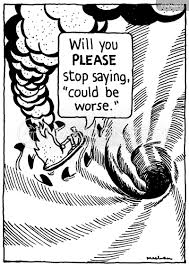
Recently, good friends of ours have been experiencing an unfolding tragedy for their family. A much-loved pet has been missing for a week and as yet, frantic searches have not located his whereabouts. In a Facebook post (one of many as they raise awareness within the community) they shared not only ways to help find their pet – but how they are feeling and seeking solace in friends and family. What prompted this month’s blog was that they felt the need to caveat and to pivot towards the invasion of Ukraine, and point out that they recognise that there are worst things going on in the world.
It halted me a little to think that there might be someone in their social circle who, upon hearing of their tragic and desperately worrying news, may feel it necessary to point out that in Ukraine families are fleeing cities and towns in which they have lived their whole lives; watching helplessly on TV as their homes are razed to the ground. These interlocutors (interlocutor is an oft used word in philosophy: it’s the name given to an imaginary – or real – person who challenges another’s point of view) may well come from a place of authentic sympathy, but I have a problem with applying a ‘could be worse’ response to someone experiencing tragedy no matter how comparatively small it is. Not only do I think it has a logical problem – it also has an empathy problem.
The logical problem I have with this ‘could be worse’ idiom in such situations is the potential ad absurdum nature of such an approach (ad absurdum: a form of refutation showing absurd consequences as a matter of logical necessity). Let’s agree that there is human suffering in the Ukraine, which we cannot doubt. It would be right to say, comparatively speaking, that the suffering of a family whose home has been shelled is worse than the suffering of an imagined middle-class affluent family whose water pipe has burst, thus flooding their home and ruining their downstairs living area. The interlocuter may say ‘It is a shame your home is flooded, but spare a thought for the families in Mariupol, their homes are utterly destroyed. However, transport that interlocuter to a family experiencing the devastation in Mariupol and, given that they apply the stoical ‘could be worse’ idiom to situations of human suffering, they would have to locate a worse example of human suffering as a matter of logical necessity. I’m not going to offer an example here as I am sure you see my point. It would be utterly absurd and to some degree inhuman to be face to face with humans and some unspeakable tragedy and point to something even more horrifying and say ‘hey, at least you’re not them’ – but that’s what the ‘could be worse’ idiom logically requires.
To pull this thread a little further, ‘it could be worse’ makes assumptions that may not necessarily be true. It may be the case that Scenario A’s material devastation is not as catastrophic as Scenario B – but, and here’s the kernel of my argument, the interlocuter cannot ever know the effect of any devastation upon the mental wellbeing of the sufferer. It could be the case that both mine and my neighbours home flood simultaneously. We are both are fully insured and whilst it is upsetting, we both can make repairs and muddle through. However, the flood is the final straw for my neighbour and is the final blow from unfortunate event upon unfortunate event. Whilst we have both experienced the same material catastrophe – we deal it with very different ways. I may take the interlocuters ‘could be worse’ idiom in the stoic nature it is given, but my neighbour’s suffering is tenfold mine and these well-meaning words could make matters worse. That’s because ‘Could be worse’ doesn’t seek to alleviate distress, only to compartmentalise and rationalise it. Well, there’s a time and a place for that.
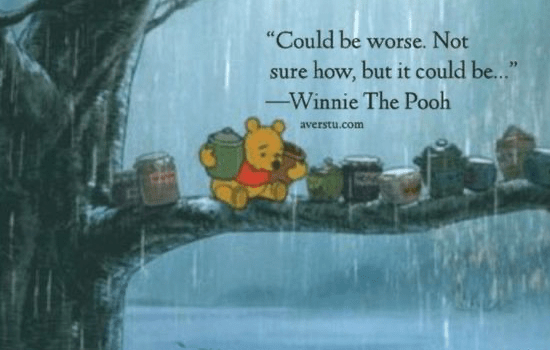
The ’could be worsers’ want to categorise suffering and place it on a scale. Scaling pain is very useful – I often ask my youngest son if his finger hurts enough for me to chop it off (and not to worry, it’ll grow back). But surely there’s a time and place to catalogue misery. What people may need in the immediacy of suffering, no matter its first blush ranking, is validation, not tabulation. Another human to recognise that what is occurring for them, no matter how big or small, is devastating for them. There’ll be time to see some perspective once reason and rationale begin to take their primary roles in problem solving. But when it is emotion that rules the day, it is empathy that should take the lead.
We cannot truly know how others are feeling when an external unseen stressor blindsides them. And we cannot assume what they need to hear is how insignificant their issues are compared to some real or second-hand story of greater suffrage. We know there is starvation in Africa and are keenly aware that right now there are human beings going through hell. But in the moment, humans need humans to help and understand. So, to all you could be worsers’ out there – just hold that desire to remind others of how awful the world is for a couple of beats and listen.

 StoatAubergine
Leave a comment