Category: Uncategorized

  • Back to Basics: A call to the head and heart – or simply ice cream for everyone?

    Back to Basics: A call to the head and heart – or simply ice cream for everyone?

    Those of us in teaching have all experienced that exhausting final term at school. Behavioral problems from the usual suspects, every teacher running on empty but pushing ourselves and our charges over the line with as little drama as possible. We try to maintain discipline with increasingly wearied and fatigued cohorts of children (whose parents also hanker for the last day of school) as we continue to operate in the long shadow of Covid. But for certain there must be a discussion on how to address the behaviour problems encountered throughout the school over those final four months. In the concluding full staff meeting before planes are boarded, bars propped up or beds receive the dead weight of teacher ‘husks’ – the plan to address issues since January are disseminated and lo and behold out trots – ‘it’s time to go back to basics.

    There’s a contrary itch in an idiom that states that to achieve progression we must first achieve regression – but I understand the mis en scene. As an appeal to the head – it’s about simplifying a complex operation and re-establishing how it works at its most basic level, and it’s easy to see how problems arise. How about this as an analogy: Over a period of time, an operating system that worked well with a basic structure whereby the main cogs ran simply and operated their primary functions without fault has incorporated into it more complex machinations. The belief being that the convoluted ways of working would either improve on the basic fulcrum of the system, meet new demands on the system or favorably tweak some issues. So far so good. Then, over more time these more convoluted moving parts start to take on the role as the new base system of operations and their more multifarious and intricate ways of working deemed ready to be front loaded yet further with systems thus causing more problems in of themselves instead of positively performing their primary function. The result is that folks look at the assembled muddle and say ‘Hey, remember when it worked really well because it was simple, and it did those simple things well…let’s just do that again!’

    The biggest issue with my mechanical analogy is that whilst we could imagine a machine which at its most basic form worked seamlessly – the same cannot be said of a human constructed values-based organization. For when a school talks about going back to basics, for example requiring pupils to line up silently before they enter the classroom, you have to ask yourself: Are we doing this because lining up is a simpler more basic way of managing a classroom before learning?  Or are we doing it because returning to some previous more basic way of working is just good in of itself?

    My assumptions about ‘back to basics’ is twofold:

    1. It implies that more complex or convoluted ways of working are to blame for errors given the nature of complexity.
    2. That going ‘back to basics’ is of itself a virtuous action – but that this can be construed as a token phrase rather than really exploring values and individual well-being.

    Let’s examine these two points:

    I will take ‘lining up in silence outside the classroom before the lesson’ as an example of ‘back to basics best practice’. Let’s ignore that this strategy suits secondary school (where pupils move about from class to class) more than it would say an Elementary homeroom teacher. My problems are not situated there. Why is lining up in silence outside the classroom considered a fulcrum ‘basic’? Is it because it works simply, or is it because it feels good?

    Let’s consider the issue that newer, or more convoluted ways of working are to blame (instead of keeping things simple) for a breakdown in school discipline before class begins. Maybe the newer system that was in place was that pupils could enter the classroom but had to get started on a task that had been set for them. In this instance, teachers would plan for an activity as students walked in that could be accessed independently that either would prepare for the main learning ahead or put them in a good cognitive mindset. This is sometimes referred to as ‘bell work’. Certainly, a more convoluted approach to the start of class discipline than lining up outside silently and awaiting the teacher’s permission to enter. However, the argument is that the new approach is more appropriate to promoting learning, though I don’t want to get bogged down by this. Let’s just state that ‘bell work’ is a more convoluted and load heavy approach than lining up outside silently. 

    Maybe there had been a problem with the ‘bell work’ approach because a teacher had gone from say a GCSE history class with 16-year old’s straight to a Year 7 class with eleven years old’s and they didn’t have time to prepare a suitably engaging activity for them to dive in to. Possibly, the previous period of teaching had been fraught, and the teacher needed a five-minute breather and lining the pupils outside gives them the space to reset? Both perfectly rational reasons to have children line up outside.

    However, that the more convoluted, but arguably more learning focused start to the class could at times be difficult to achieve, does not necessarily mean that it in itself is at fault for a breakdown in class discipline. Its more complex nature compared to simply lining them up does not necessarily make it at fault. Maybe the convoluted ‘bell work’ approach works, but meaningful help needs to be offered on supporting that teacher with different strategies when switching between grades. In this operating system (discipline and order before class) ‘bell work’ is a great way to engage children in being ready to learn – there’s nothing wrong with it. Therefore, to that end, there’s no need for a return to basics – we just need to take more time and give more care to embed a newer way of working because it’s not 1955 anymore and research has moved us on. Oops! Did you see what I did there? I threw in a little ‘values’ wink. Am I suggesting that when we talk about going ‘back to basics’ we are talking about a more ‘simpler time’ rather than a simpler way of working? There are ways of working throughout history that still work today…but sometimes ‘back to basics’ isn’t an appeal to review the machinations of a way of operating to ensure the foundations are sound – for at its worst, it’s a values laden treat:  churned creamily with simplicity, dipped in sumptuous good old fashioned values and sprinkled with straight talking – no nonsense sparkles. Mmmmmm…so comforting.

    As it happens there is, I think, an argument that going back to basics is in of itself a virtuous action. I make a play on how it can be used to give a false sweet sense of comfort that things will improve irrespective of the context, but for me that is where the issue is. If you were to say to a group of beleaguered or confused people that the plan was to go back to basics – there may well be a sense of relief and a hope for a more direct path. That said, it’s virtue is not located in its promise for a simpler time (that may have never really existed, except for false memories or dominant discourses)  – it is its link to asceticism. That is its virtue.

    Asceticism, in its strict religious meaning, is stark self-discipline. A rejection of any indulgences; abstention from practices that may cause erring or swerving the most pious path. If I can dilute this harsh definition – I think it would be fair to say that most religions hold it to be true that living a simpler life, a life less over burdened by technology or one that shrugs off over complicated or convoluted ways of thinking or acting , as a ‘good’ life. And intuitively we feel it to be so – think of detoxifying, de-cluttering, breaks from social media…these are viewed as important if not necessary ways of recentering and recalibrating what is important and what works. So much like our machine analogy at the top – seen through the lens of a virtuous action; going back to basics from a personal almost ‘spiritual’ way will inevitably offer some insight into why a way of being or acting is causing consternation or a lack of productivity. And there is benefit in that. There is benefit in going to back to basics both in personal reflection and in reviewing an operating system that may be at fault.

    So what’s the problem?

    Therefore, the problem arises when going ‘back to basics’ is a token gesture. This idiom should not be free from constructive criticism. When someone tells you they are taking something ‘back to basics’ are they offering a plan to reflect and review on a way a thing functions?  A chance to re-establish what we know works and really try and embed newer systems to work well and not reject them because complex necessarily equals complications. Are they offering the space and time for an individual to re-calibrate and re-assess what is ‘good’ for them? Giving folks time to mentally recharge. Or are they simply hoping you’ll hear in your mind the faint lilting chimes of the ice cream truck – wistfully recalling how you once could leave your doors unlocked at night, no one had a mobile phone that now ruins everything and a tenner could buy you a movie ticket, fish and chips on the way home and still have change for a mortgage. And in your reverie, you agree to whatever is suggested because ‘back to basics’ feels like it can only be a good thing, right? Don’t be afraid to challenge this idiom when it’s presented to you whether it be an appeal to the heart or the head – but always accept a scoop of ice cream. 
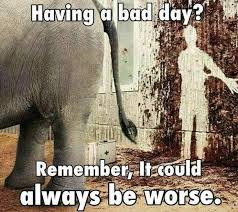
  • You know, they’re starving in Africa – The trouble with the ‘could be worsers’

    They’re starving in places all over the world – but the plight of thousands in Ethiopia was brought into stark relief across the globe during the 1983-85 famine by the worthy and incredible efforts of Bob Geldof and anyone whom he grabbed by the collar and ‘voluntold’ their services for the relief of suffering. Meanwhile, across Britain, schools did their part in raising awareness and funds to alleviate the suffering of over seven and a half million Ethiopians as for once, the West took notice. 

    I was ten years old when Live Aid aired in 1985 and I would wager that those of you reading this post of a similar age would have been, like me, the first generation to have been introduced, should you be whining or complaining about…well, anything really, to the a new and impenetrable comparison to whatever ailed you…”They’re starving in Africa you know”

    It’s true of my experience and I bet it’s true of yours. There was no individual injustice, personal effrontery or keenly felt unfair result that couldn’t be diminished, shrivelled like the old Coke bottles we’d throw into the backyard fire at my nan’s house to watch them melt, like your mum or dad looking down at you, their faces set in a principled relief, bursting your puffed indignance with “Well, they’re starving in Africa”

    The purpose of this phrase was to give you a sense of perspective. That your troubles pale in comparison when lined up against a fellow ten-year-old in Ethiopia, aching in hunger, devoid of agency and watching tribe members senselessly perish whilst you, are simply crying over an event that will most likely be forgotten by the time Doctor Who is on. As a parenting tool, the phrase was a useful and a meaningful instrument to teach children empathy, a broader outlook, and to self-regulate when life’s trials felt overwhelming. 

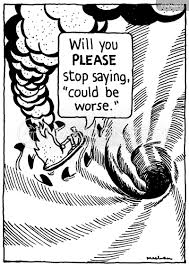
    However, there might be a problem with a ‘could be worse’ approach to alleviate suffering as we get older and more ingrained in the ‘human condition’. It whiffs of eau de contradiction to suggest that I will make you feel better by conjuring more horrifying circumstances for you to consider – but it may border on the sociopathic to apply that approach to anyone experiencing an objectively terrible life incident.

    Recently, good friends of ours have been experiencing an unfolding tragedy for their family. A much-loved pet has been missing for a week and as yet, frantic searches have not located his whereabouts. In a Facebook post (one of many as they raise awareness within the community) they shared not only ways to help find their pet – but how they are feeling and seeking solace in friends and family. What prompted this month’s blog was that they felt the need to caveat and to pivot towards the invasion of Ukraine, and point out that they recognise that there are worst things going on in the world. 

    It halted me a little to think that there might be someone in their social circle who, upon hearing of their tragic and desperately worrying news, may feel it necessary to point out that in Ukraine families are fleeing cities and towns in which they have lived their whole lives; watching helplessly on TV as their homes are razed to the ground. These interlocutors (interlocutor is an oft used word in philosophy: it’s the name given to an imaginary – or real – person who challenges another’s point of view) may well come from a place of authentic sympathy, but I have a problem with applying a ‘could be worse’ response to someone experiencing tragedy no matter how comparatively small it is. Not only do I think it has a logical problem – it also has an empathy problem.

    The logical problem I have with this ‘could be worse’ idiom in such situations is the potential ad absurdum nature of such an approach (ad absurdum: a form of refutation showing absurd consequences as a matter of logical necessity). Let’s agree that there is human suffering in the Ukraine, which we cannot doubt. It would be right to say, comparatively speaking, that the suffering of a family whose home has been shelled is worse than the suffering of an imagined middle-class affluent family whose water pipe has burst, thus flooding their home and ruining their downstairs living area. The interlocuter may say ‘It is a shame your home is flooded, but spare a thought for the families in Mariupol, their homes are utterly destroyed. However, transport that interlocuter to a family experiencing the devastation in Mariupol and, given that they apply the stoical ‘could be worse’ idiom to situations of human suffering, they would have to locate a worse example of human suffering as a matter of logical necessity. I’m not going to offer an example here as I am sure you see my point. It would be utterly absurd and to some degree inhuman to be face to face with humans and some unspeakable tragedy and point to something even more horrifying and say ‘hey, at least you’re not them’ – but that’s what the ‘could be worse’ idiom logically requires. 

    To pull this thread a little further, ‘it could be worse’ makes assumptions that may not necessarily be true. It may be the case that Scenario A’s material devastation is not as catastrophic as Scenario B – but, and here’s the kernel of my argument, the interlocuter cannot ever know the effect of any devastation upon the mental wellbeing of the sufferer. It could be the case that both mine and my neighbours home flood simultaneously. We are both are fully insured and whilst it is upsetting, we both can make repairs and muddle through. However, the flood is the final straw for my neighbour and is the final blow from unfortunate event upon unfortunate event. Whilst we have both experienced the same material catastrophe – we deal it with very different ways. I may take the interlocuters ‘could be worse’ idiom in the stoic nature it is given, but my neighbour’s suffering is tenfold mine and these well-meaning words could make matters worse. That’s because ‘Could be worse’ doesn’t seek to alleviate distress, only to compartmentalise and rationalise it. Well, there’s a time and a place for that.

    The ’could be worsers’ want to categorise suffering and place it on a scale. Scaling pain is very useful – I often ask my youngest son if his finger hurts enough for me to chop it off (and not to worry, it’ll grow back). But surely there’s a time and place to catalogue misery. What people may need in the immediacy of suffering, no matter its first blush ranking, is validation, not tabulation. Another human to recognise that what is occurring for them, no matter how big or small, is devastating for them. There’ll be time to see some perspective once reason and rationale begin to take their primary roles in problem solving. But when it is emotion that rules the day, it is empathy that should take the lead.

    We cannot truly know how others are feeling when an external unseen stressor blindsides them. And we cannot assume what they need to hear is how insignificant their issues are compared to some real or second-hand story of greater suffrage. We know there is starvation in Africa and are keenly aware that right now there are human beings going through hell. But in the moment, humans need humans to help and understand. So, to all you could be worsers’ out there – just hold that desire to remind others of how awful the world is for a couple of beats and listen. 

  • Regret: And why wishing it was different is a wasted wish.

    Regret: And why wishing it was different is a wasted wish.

    In this months blog I have been reflecting on ‘regret’. Regret is  an emotion that, unlike its more fleeting extended family members, can stay with us for the entirety of our lives. It comes to us at the lowest point and whilst its attachment to our souls can be light enough to bear; it can often be so burdensome that learning to live with it can take a lifetime. However, when we accept its encumbrance, it can facilitate healing and, in some ways, let us experience what it means to be a truly vulnerable, imperfect, humble and hopeful human.  There are times though when we would do anything but confront regret, but we can’t change the past – so why does wrestling with regret often mean trying to unpin ourselves from that we have no earthly power to manage? 

    We can regret our own past actions, past actions of others, future actions and acts not even committed. I remember many years ago, fresh out of theatre school, I was asked by my former drama teacher if I would like to pop back to my old secondary school and lead a GCSE drama class. As the topic was ‘movement’ one such exercise involved watching each other walk around the room to try and determine a character trait. One girl walked a couple of circles and as we watched I made a mental note to ask her why she had her arm tucked into her jumper during the whole exercise. When she stopped (to a trickle of applause) I fully realised, she only had one arm. The words ‘why was your arm tucked into your jumper’ were literally forming in my mouth, awaiting a single draw of air to make them real. I gobbled them up. But here I am, some 30 years later, regretting the thought and, even more bizarrely, regretting ‘what might have happened?’

    And it is this facet of ‘regret’ which I find the most puzzling. What might be the possible ‘good’ in mentally revisiting something we regret? What might be the reasons we ponder so on how things ‘should’ve been’ if only we had the chance to do it again?

    Why do we regret that which we cannot change?

    At its best – regret is a teacher. A harsh teacher, but an honest one – and one who knows that the lessons learnt will last a lifetime. Regret can inform us on how to do better or act better should a similar situation arise. Regret teaches us to be humble and to seek forgiveness of others when those sorrowful feelings are authentic and deeply felt. At its best – regret makes us better people. In some ways, it hoists us to the highest part of our humanity: selflessness. 

    But that’s some monolith of an ideal to scale. When you reflect on the periods or episodes in your life when your actions have had negative consequences for yourself or for others – have you always managed the high level of reflection and communication needed to obtain the sagacity of regret along with the vulnerably to accept its enlightening potential – or do you just wish you could’ve rappelled back down, gone back and done it differently?

    There could possibly be some good in revisiting a regretful episode to glean some learning from it. Maybe there’s a puzzle element in this recounting and revisiting that could have some value. Maybe if I had said x instead y then z would not have happened which ended up being a negative and uncomfortable experience. Maybe, if having said y instead of x your pet cat ‘Tiddles’ may have found the power of speech and finally had the chance to tell you that they’ve had ‘proper’ tuna and that ‘Whiskas Tuna’ tastes nothing like the real thing. You see what else we can do when we permit ourselves an unobtainable fantasy? There is a difference between learning about ourselves and connecting with a wrong-doing and reimagining a fantasy world where everything turned out right in the end. 

    It is our nature to wish things could have gone better. I cannot begin to tell you how many arguments I win in my head whilst showering in the morning. I mean I am slaying my interlocuters. It’s embarrassing really. But when the shower is turned off and I realise that that the sound of blood rushing to my head was drowning the sound water beating against it – I am no better off, I am no wiser for the exercise. 

    And yet, it is still done. We still revisit, recount and replay knowing full well that the scenario in our heads my change, but the reality stays the same and there is no replay only repair; there is no redo…only regret.

    So, what exactly are we ‘regretting’ when we refuse to accept that which has already happened? Clearly, there is the regret of the negative outcome and to whomever that had afflicted. There is also the regret that our character has been stained by the event – maybe to such a degree that no ‘walk-back, double down, 90-degree cotton spin cycle’ could ever shift it. So, to some end, ‘regret’ here could be that we hadn’t spotted a way out. If we are replaying the incident in our heads, we are not searching for a solution (for that is impossible to attain) we are searching for an excuse – a way of viewing it differently. To this end, when we replay and revisit – we are not wishing for a better outcome or seeking the learning moment, but instead – like a pit-bull defence attorney, stalking a witness and eyeing a changeable jury – we are searching for the evidence to prove we were not in the wrong. Ultimately, we are seeking an acquittal from regret and move to the less serious crime of ‘well, I’m sorry I made you feel that way’. If we can sidestep the impending ‘regret verdict’ – that could seem like a win.

    Because that’s the problem with regret – its finality. Once we are tried, we are sentenced. Maybe the desperate actions of replaying and recounting could be the first steps in a grieving process – denial – for if we’ve wronged, we know what comes next – and it ain’t always nice.  It’s like a sprawling dark theme park, mournful and sullen with rides upon rides, each one requiring you to experience an emotion that’s unwelcome, uncomfortable and may possibly require another turn.  But ride them we must for if we fully accept our culpability and enter our guilty plea- there’s no turning back. You gotta buckle up and settle in. The journey through regret is ours to take, but not always ours alone.  

    It’s irrational to relive the past and believe that in doing so it will change. It’s disingenuous to relive and replay an event, if we were totally culpable, in order to win out on a technicality so as to avoid the longevity of discomfort regret can bring. If we choose to regret that which we cannot change, it is most likely to no positive end. What is done, is done.

    Regret, instead, is the beginning and not the mournful end. 

    Conclusion

    I would bet that accepting blame, pushing through its challenges and actively seeking to repair has actually levelled you up. There’s something about the truthfulness and vulnerability of owning our constant imperfection that provides an opportunity for growth. To touch the face of perfection rather than don its mask. I would also bet that not every regretful episode has been profoundly despairing, with some finally yielded a positive nurturing mindset. The consequences of our negative and regretful action don’t end with everyone looking peeved and the rolling of credits to a melancholic piano. How regret informs an ‘ending’ is unknown. But a mindset that personal growth, nurtured through the repair to those harmed can be known and that such a mindset reminds us that our ‘ideal-self’ is not always an abstract fantasy.

  • Facebook ‘In-Memoriam’ – Finally, a gift from the social media giant.

    This month’s post takes on a deeply personal note. Earlier this month a friend of mine, and to many in the hospitality community of Leeds, died far too soon. As with previous recent personal losses, I have found the Facebook Remembrance pages a real comfort and something of a ‘living’ memoriam. In this post I will share my views and insights on this service provided by FB and why I believe, against the myriad of things they do that make me question my ‘membership’, it is something of true value. 

    To the lay persons amongst us – Facebook is a bright, red pocked reversed saltire of organized chaos. Its innumerable features come and go like guests at a party with each one either improving with age or ignominiously leaving without a parting word. In the 14 years I have used the social media platform I’ve kept the number of bells and whistles I ring and play with to an absolute minimum. However, when my brother passed away in 2015, we had to address his social media identity. Simon was not an avid user of social media per se – but he enjoyed posting on subjects that were close to his heart: such as the local community buzz and his passion for cars. When Simon died, we had to organize for his Facebook profile to be changed to ‘Remembering…’. I don’t recall it being a laborious process; one more sorrowful light switched off as we cleared the rooms of a life lived. However, his remembrance page became a place where friends and family could share pictures and memories as we all expressed our grief and came to terms with our loss.

    It wasn’t until a few years back when the full capacity for Facebook remembrance became more visceral. In February of 2018, one of my closest friends died after fighting lung cancer for twelve months at the age of 42. David and I first worked together at The Wardrobe restaurant and nightclub in 1999 and remained very close for nearly twenty years and shared, unlike my brother, a wide and very active social circle. At the time of his death, he had a five-year-old son, and my two boys were six and eleven respectively – so we shared lives beyond the hedonism of our twenties and well into the ‘middleship’ of our new families. I was certain we would see retirement together and fill the autumn years of our friendship with time spent reminiscing to the sounds of laughter from our respective grandchildren. His death was a hammer blow. A desperately unfair event that came with no justification – just a steep drop off a smooth unforgiving cliff face with no ridges, hand or foot holds to cling to and take stock – until his Facebook profile moved into ‘remembering’.

    It quickly filled with pictures, videos, stories of rum-fueled, beer powered exploits through the bars and restaurants of Leeds a number of which we worked in or opened together. It became a place to find purchase – to pull ourselves into a place of some security – where grief ‘could happen’ and be shared across time zones and free from geographical boundaries. To this extent – it operated as a traditional ‘In-Memoriam’

    The concept of ‘in-memoriam’ has been a western stalwart of the grieving process for over a millennia. An opportunity for all who knew the departed soul to mark make on how their living spirit had touched their lives and shaped their own identities. It also operates as a grief-marker for those of us forced to live ‘after-life’. 

    The concept of ‘in-memoriam’ has been a western stalwart of the grieving process for over a millennia. An opportunity for all who knew the departed soul to mark make on how their living spirit had touched their lives and shaped their own identities. It also operates as a grief-marker for those of us forced to live ‘after-life’. 

    ‘After life’ is an interesting term. Within everyday conversation it refers to those who believe in an immaterial soul whose existence carries once the body has ceased to be. We can never truly know whether this is true, but we do know that we ourselves, those ‘left behind’, must lead lives ‘after’ the passing of a loved one. To this extent it is we who are experiencing an ‘after-life’. David’s death and the use of his FB ‘Remembering’ page gave an added dimension to coping ‘after-life’ and remains a way of coping to this day.

    Our Facebook pages are an extension of our identity – an updated digital representation of our conscious minds. Though it is managed by us, its necessary component is that it is co-constructed with friends and family. So even though it is our conscious mind that creates and updates our profile – that other important element, the part co-constructed by others…continues.  So, unlike a ‘book of remembrance, ‘remembrance’ becomes active. The architect has passed on – but we, the friends and family keep building.  David was a chef by trade and taught me a great deal about how to love food. Not long after he died, I was at a friendly gathering where a professional chef and friend to the host was cooking. My eldest son donned an apron got stuck into the ‘mis en place’. David would’ve loved this, I thought. So, a quick snap of my son in his makeshift ‘whites’ made its way to David’s page and was quickly ‘liked’ and discussed by David’s friends. And this is how it warms the refuge of our grief. Our FB identity is our community of friends. We can post and comment and share on the episodes of our life that he would have found heart-warming, funny and irreverent! We are not all living some covert illusory consensus – we know he’s dead. But his identity is not. It literally lives on through this place where his personality, his history and his face and voice remain accessible and engageable. 

    The Facebook Remembering service has truly been a gift for me personally – and it’s such a treat when friends post videos they found on their phones, or visit a place special to them that reminds us all of David’s life and presence. There’s also potentially a place for his son to visit, to discover David’s life and how much he meant to so many of us.

    Remembering Tom (my friend who passed earlier this month):

    Tom, you were such splendid company. You supported my blog when I started it last year and were one of the first to subscribe. We enjoyed many discussions and debates as our paths crossed numerous times across the hospitality sector in Leeds in the first decade of the new millennium. You were defined by a warm gruffness that suited the identity of an old soul whose sarcasm and ironic disposition could be unwieldy and hurtful in less experienced hands. Instead, with you, it came as insightful, comical, and always with an earnest heart. The sadness of your passing is amplified by the young family left behind who must now forge ‘after’ lives without your companionship. However, as grief requires us to fashion a ‘new normal’  the core materials that forged the  legacy of your identity – your work ethic, your authenticity and your capacity for love are forever present and will provide the foundations for your children’s identities and will be the substance of their resilience. 

    Tom’s family have chosen ‘Cloth Cat’ as a place to donate instead of flowers. A dynamic organization that provides music education and opportunities to children in the more deprived areas of inner city Leeds. 

  • TikTok, Neo-Pronouns and The Construct of Reality.

    Warning!

    This blog will contain a middle-aged man talking about TikTok.

    Yes! This blog is going to involve TikTok, okay! I can talk about TikTok and not have to reverse a baseball cap, cross my arms and summon an ice-cold phrase like “your cappin, bruh”.

    Stay. Don’t go. That first paragraph may only have been funny in my head.

    This month’s blog is a blend of philosophy, sociology and how both those disciplines informed a parenting opportunity to explain a few more ‘whys’ about the world. 

    If you have teenagers, live with teenagers, or teenagers play a role in your life – it’s good to project a presence in their sphere of influence before they wipe you out completely with one swish of their finger. Fortunately for us, our eldest is still happy to include us (selectively) in his world and it is not uncommon for him to emerge from his bedroom and come downstairs to talk about the latest TikTok encounter that has left him perplexed. Before I get into this – can I just state that I like TikTok (which, given my demographic, has just dropped its share price by 80%). But I do! What I really like is that it does provoke debate. For our eldest (let’s call him ‘Number One) TikTok represents a portal into the wider, more complex world, the world that we ‘parent-bots’ are obligated to prepare him for. So, let’s take this opportunity to dig deep, unpick and hopefully enlighten. 

    “Come back Number One, and unroll your eyes from the back of your head…this might be interesting”

    A topic that has yet to fully shake itself into some semblance of order, and one that has irked him for longer than previous videos is the subject of ‘neo-pronouns’.

    Neo-Pronouns or ‘new’ pronouns are an extension of the established singular personal pronouns such as ‘he and she’. ‘He and She’ refer to the establish binary genders of male and female.  However, for persons who don’t identify with either male or female binary constructs, (persons referred to as ‘non binary’) ‘neo-pronouns’ offer an alternative ident crucial to their well-being and sense of self. For more insight on what these neo-pronouns look like, check out the link below:

    https://www.unf.edu/lgbtqcenter/Pronouns.aspx

    Number One had no problem with this, his problem was with some of the more bizarre neo-pronoun epithets being requested via TikTok such as rabbit, pussy-cat and kitkins but I could see that the bigger question was how established truths taught in school and reinforced by social interactions (like boys are ‘he’ and girls are ‘she’) could suddenly be so questionable. What other established truths could be unmasked? Was anything real?

    Well, Number One, there’s a handful of threads there we just don’t have time to pull on right now. However, there’s a sociological perspective which might offer an insight into how it can be that whilst it’s obvious what men and women ‘are’ – we can still say that there’s a fluidity in their meaning. 

    It’s about a sociological perspective called ‘social constructionism’ and its daft Uncle ‘Post-Modernism’ and rational Aunt, ‘Epistemology’. I don’t know if the whole family analogy’s gonna work here – so let’s stick to Social Constructionism and put the ‘Uncle, Aunt’ and the history lesson back in the box.

    Social Constructionism rejects ‘meta-truths’ such as pink is for girls, blue for boys  and gender is objective based upon the observable and universal truth that girl babies are born with vaginas’ and boy babies have penises. Put as simply as possible: social constructionism is the perspective that our reality (as we know it) is socially constructed – put together by ourselves and others both from our personal sphere (family, school, church) and the larger spheres (government, media) that form our society.  It’s not a clandestine, Rothschild operation! It’s a sociological perspective based upon previous philosophical concepts and good old fashioned research. It means that how we understand the reality we daily experience is based upon not only our own subjective experience of the world (what we ourselves touch, taste, see and hear) but the sharing of ‘consensual truths’ (that we all agree the grass is green) and shared semantic truths (how we name things and what those names mean). So we have blend of what we think is so, and what we all fundamentally agree is so.

    We must be wary, however, that possibly all semantic truths (taught definitions of things) were given to us by other folks who themselves – constructed those truths. For example – if you want to be a successful fashion model you will need to be thin. Why? Because the people that dominate the modelling industry in recent modern history have claimed the language and the construct of what modelling is. Therefore,  if I told you to think of a catwalk model – your mind may picture a tall, thin woman.

    We should accept that social constructionism is a solid enough theory to give it some attention. It has been of tremendous use in challenging prejudice, racism and sexism – questioning authority and demanding deep dives into the  semantics, cultural norms and traditional values  which rule our society  and dominate the interactions within our personal and collective lives.

    Men and Women both have different reproductive organs, given different names – names we all agree on. But if we were to transplant the male reproductive organ directly onto a woman – would that automatically make her a man? It intuitively doesn’t feel like the reproductive organ does enough to confer gender. It should do because a man has a penis and we all know its called a penis and all agree to what it does and where it is – so that’s enough for a human to be a man, right? The answer of course is that our sexuality and our gender identity is not simply the clump of cell, skin and muscle that make our private parts. We know there are a constellation of  psychological, mental, emotional, environmental and cultural stars, creating and defining our sexual and gender identity. And each of those stars are prone to change and are constructed socially, and because they’ve been constructed socially, there’s a chance their semantic construct (what they are named) and the shared ‘truths’ about them (what we all agree on to be so) has been created by powerful persons in the past.

    For example, when the powerful maxim that men are the breadwinners and women stayed at home to raise children became societally fixed – there was a consensus on its truth. A truth buoyed by biologists (only women can have babies) evolution theory (men are genetically programmed to hunt and provide) and religious doctrine (Adam the first human in the image of God – man as head of household) and ta-hah…the labor preferences (where each gender’s contribution to society is best served) between men and women became as pronounced and as set as the physiological one and in fact; became an essential component.

    But that labor difference of a man and woman’s place in society is not an objective biological truth. It isn’t so that having a vagina and a physical ability to lactate means you stay and raise children. Of course women can have babies, raise a family and work full time and of course men can have babies (adoption ) raise a family and work full time – so the physiological differences are not necessary upon what each gender can do in their family and their societal roles. What made us believe it to be this way? Those who dominate the agenda – dominate the language. As a nice analogy, let’s have Meryl Streep explain it to us:

    But even the concrete assertion that our genitalia confirm objective gender can be questioned. Consider the rare condition of ‘ambigious genitilia’. For this condition neither sex is clearly present. The social constructionist has no problems here as they know that gender is socially constructed therefore the person growing and developing with this condition will be defined as more than what the condition delineates for the confused biologist. For whilst the pervasive and powerful elements of society will label and construct meanings for the child, the child as they grow into a more sentient and rational adult will also have (hopefully) the power to construct their own meanings and ways of being. For the objective realist – the lack of certainty of a condition such as ‘ambigious genitillia’ will mean them putting a reluctant foot into a world which questions the kind of grand truths the objective realist swears by every day.  

    However, this is where I should stop pitting the two sides against each other and to pull back from an ivory tower over-view effect. In the real world, of course we accept that some things appear universally real and agreeing on that is important and equally some are up for debate, whether morally or in terms of their existence. We need to consent on shared knowledge, but we also need to recognize that not all truths are universal. And this is key to social justice campaigns such as gender equality. If some narrow view of evolutionary bioethics is to be believed than men were meant to be hunter gathers and women child bearers and homemakers. Social constructionism saved us from such a myopic and limiting view of the role of the two sexes and now we push back against any suggestion that there should be set gender roles based upon physiognomy. What happened next when it comes to LGBQT and transgender is the next stage in our progress in better communicating and understanding each other’s differences. 

    Conclusion:

    This isn’t a blow by blow account of my conversation with Number One son! I introduced him to how it is possible that seemingly irrational things can exist. Of course men can have babies for what is a man? Of course we can jump to the moon if we employ logical possibilities instead of physical possiblities. Billions of humans all over the globe put their decision-making processes and moral responsibilities into the hands of a divine being that cannot be objectively seen or measured. – and for those rationale theists, there’s nothing confusing about that at all. The purpose of it all is about how we wish to be seen and wish to be heard – flexing our freedom of thought and our sacred individuality. If a TikTokker is laying out their neo-pronoun stance because that is how they wish to be seen and that is how they wish to be heard then there is no harm in that.

    But running that freedom of thought and expression, powering that ability to question established truths and co-construct new ideas is the engine of social constructionism. It is not a perfect engine – but it has been a charioteer of change which whilst discomforting for some individuals; social constructionism drives, somewhat ironically, individuality itself. 

  • Our Identities and Our Responsibilites.

    In this month’s blog, I will suggest that when we think of our own identity, it can be misleading to believe that it is the same thing as us being independent, individual persons. In fact, our identity is comprised of many components and by being part of many social and cultural groups. I am Dillon Wolfe, an individual person. There are no other Dillon Wolfe’s, like me, existing as I do now in this time and in this place. However, in terms of my identity, I’m not the only Dillon Wolfe ‘man’ or Dillon Wolfe ‘father’ or Dillon Wolfe ‘teacher’. ‘Man, Father, Teacher’: these are all groups or communities the membership of which is not only how I identify myself, but how others identify me. 

    What do I mean by identity? I mean that through recognising or idenitfying which groups I belong to, others have a clearer idea as to my obligations, my passions, my skills, my ideologies etc. In other words, ‘who’ I am can be reasonably, if not wholly accurately, inferred from my group memberships. If this has traction, then how responsible are we when others within our community act reprehensibly? Are we obligated to speak out against terrible actions committed by community members because it harms our own identity as good consistent individual persons? Or does our own individuality preclude this, and instead permit us distance from how our communities act? I will argue that we are our communities and that, as a member of the community of men, I am obligated to speak out against the impermissible and intolerable behavior of that community. For to be silent, or worse to be supportive of such behavior not only harms me personally, but stunts the flourishing of that community.

    https://www.independent.co.uk/news/uk/crime/sarah-everard-missing-met-police-b1814958.html

    The shocking murder of Sarah Everard, at the beginning of March this year, stunned the UK. What transpired throughout the rest of the month prompted a global reaction, mostly an outpouring of not only sympathy for Sarah and her family, but empathy for the strata of harassment women face from men on an all too common basis. This harassment ranges from sexually vulgar language in the street, to women armed with house keys when walking home alone at night and of course to the horrific events that led to Sarah’s murder. As the month has progressed and the case developed, as did the deeper the discussion into the problem of ‘men’.

    I will never forget one of the first journal articles I read as a Social Work undergraduate was around the ‘problem of men’. Its theme was how, if present at the home, a man can be a risk to his wife/partner and their children in terms of domestic abuse and/or child abuse and yet when absent – he is problematic by providing no fiscal support for dependents and the long-term emotional damage faced by children with absent fathers. I remember being stunned by the article and, whilst recognizing the academic context within which it was written, I was disconcerted by the bleak picture of men being painted – a picture made real by my own observational experiences in social work practice.

    Events such as Sarah’s murder cause shockwaves. Not just of shock and grief, but also how we function as a society. When a social bomb such as this explodes – the shrapnel flies into areas across our cultural field. One such piece which lodged in the craw of newspaper editors across the world was the notion that it is ‘men’ who must shoulder some of the blame and that it is men who are the problem. When Baroness Jones, a Green Party peer, suggested men should have a 6pm curfew it was meant as a retort to the Met Police’s own advice that women should avoid going out at night on their own – a tacit admission by them that sexual harassment against women is, like Covid, ultimately incurable and at best, chronic. What followed for Baroness Jones was another predicable social media (male) malaise – the incensed misogynist: full of threats of violence and threats of death. However, a line that came through often and to all intents and purposes in the defence of men was the bumper sticker: ‘not all men are bad’. Whilst the truth of the statement ‘not all men are bad’ is debatable (define ‘badness’ for example) let’s narrow it, and understand it in the context of the sexual harassment narrative women face daily and ask: Don’t I as a man and all the fellow men I know have an obligation to act not only to protect but also to better the community into which we belong?

    Integral to my argument this month about the phrase’ not all men are bad’ and its drinking partner ‘a couple of bad apples’ is that they attempt to distance the speaker from a community to which they belong and a community they are obligated to act upon to correct mistakes. For whilst we may think of our identity to be a monolithic – we are in truth identified by the multiple groups or communities to which we belong. Therefore, if one of our communities fails, and we as an individual agent or person fail to act, we may not be representing the very best of that group and could be tethered to the individual or their acts which brought the group into disrepute.

    Let’s get some clarity by asking an obvious and ultimately daft question – am I, as a man, to blame for Sarah’s murder?

    Of course, I am not to blame for Sarah’s murder or for any other crimes committed by other men against women. However, if I don’t accept the evidence that there is an issue with men’s behaviour within the context of the treatment of women and seek to move the needle – I am not fulfilling my obligation to be my best self within that community and uphold the goodness of that community’s nature – particular as a father of boys. This could cause a situation whereby I am tacitly condoning such awful behaviours with my silence.

    It does appear that there are some folks who either find it difficult , or fail to see the issue with, understanding that whilst they are indeed an individual ‘person’, that ‘individuality’ and ‘identity’ are not the same. Our identity comes from being part of a ‘community of persons’. My identity is defined from being part of the community of men; community of Everton football supporters; community of teachers, of social workers, of fathers etc. When a Social Worker was on the front page of a tabloid having failed to protect – we as a community of social workers all felt the sting, shame and regret and all shared the burden in seeking improvement and bettering our practice. When my football team fails to win a game or its players act in impermissible ways – I don’t stop supporting them, or claim that my identity as an Evertonian is only when it makes me feel good. People would question my commitment to a group and also the nature of my own personality if I flip-flopped between my communities when something was wrong. 

    Our identity is not separate to the communities which define it, they ARE our identity. Clearly there’s no single definition of what a ‘man’ is – but being part of that ‘community of men’, I strongly believe, is about having a consensus on some of the critical defining points of what a man is including, and this one’s up there with ‘penises’, not abusing women.  And yes, unfortunately, our communities fail us as well as lift us up. It’s a fluid relationship – but it is still a relationship that requires work and honesty and for me, my membership to the community of men is life-long.  I am identified as man not because I held a meeting and told everyone – but because of the myriad of pixels that comprise the physiological, psychological, sociological and philosophical identity of ‘man-ness’. Those numerous-pixel points when seen as a whole, bring in to focus a picture of ‘manhood’ that is significant to my identity. I would argue that whilst others in my community can debate which of the pixels has the most significance and which ones are necessary and which contingent – there is a broad consensus as to what constitutes a man.  Therefore, to observe the actions of the ‘community of men’ that are reprehensible and NOT condemn it, and NOT call it out and NOT support the victims of such actions is impermissible because we ARE our communities. 

    Conclusion

    When the community of men fail, which is depressingly often, I am attached to that failure. Our obligation to act when one of our communities’ fail is because if we don’t, then it is our nature as good moral persons that suffers. I suffer when my community fails and vice-versa. Clearly there are some communities we can walk away from, but there are also some that we must change when we something rotten. I would therefore question the membership of any one of our community of men who hid behind the illusion of their independence from our group.  

    atheists Belonging children education ethics Expats free speech Freewill gender gender neutral God identity inspirer's International language learning men Neo-Pronouns parenting parenting advice parents Person Philosophy Philsosophy politics Pronouns reflection relationships Religion self-help self-regulate self-soothe social social learning social media social work sociology teachers teaching theology Third Culture Kids transcendental twitter vaccinations work

  • Pupil or Student – Is there a more suitable noun for today’s child learners?

    In this month’s blog, I will argue against naming school-aged child learners as ‘pupils’. I will suggest that calling them ‘pupils’ is at best simply naming a child who goes to school and at worst it is idealistic and out of touch with modern pedagogy – promoting the outmoded product of a dependent taught child. I will then offer the argument that to promote the image of a school child who doesn’t simply attend school for instruction but as an active learner who is studious by nature – then only the term ‘student’ will suffice.

    My wife and I are both teachers. Now in her twelfth year, Mrs. Wolfe is significantly more experienced than I having taught in one Europe’s largest secondary schools in West Yorkshire followed by seven years teaching internationally in Asia and North America. We have worked in schools that have called child learners students and schools which call them pupils. My wife really hates the term ‘pupil’. In fact, this debate was her idea. I told her I would consider it philosophically and she could do the actual research. When she is typing reports, I can hear the extra punch saved only for the sequence P-U-P-I-L. But why is this a problem? Does it matter? And if it does matter – is there a reason why one term should be preferred over the other?

    A good place to start is with a definition:

    Pupil: a child or young person in school or in the charge of a tutor or instructor Originating from the 16thcentury Middle English pupille (minor ward), from Anglo-French, from Latin pupillus (male ward) from the diminutive of pupus (boy) and pupilla (female ward), from diminutive of pupa (girl). 

    Student: One who attends school; one who studies; an attentive or systematic observer. Originating in the 16thCentury Middle English, from Latin student-, studens, from present participle of studēre to study.

    Merriem webster – online dictionary

    We can see some similarities and some differences that will go straight to the heart of the matter and also explain why Mrs. Wolfe’s nervous tick is so pronounced during report writing season.

    In terms of etymology, both terms originate from some form of Latin (no surprises there) but each sketch a different picture about the nature of the child learner. If we were to simply rely on the definition of each term and its etymology – then ‘pupil’ is a child who is in ‘the charge of another’. Deriving from a word meaning ‘ward’, the term ‘pupil’ (like Batman’s sidekick) is a young person who is watched over by someone other than their parent. Therefore, the nature of a pupil is one who is dependent upon instruction. A student on the other hand is one who ‘studies’ and that verb study is intrinsic to its definition because it casts the mould of a learner  – with a degree of independence. A learner for whom studying and learning are within their nature. 

    With our terms defined and to some extent explained, why is calling a child learner a ‘pupil’ an issue? The problem lies in an apparent contradiction. Of the schools I have worked in and the current pedagogy as it is – our learning institutions should be promoting independent critical thinkers, not children who are simply in the instructional care of their teachers. Furthermore, to stick with pupil because it best categorizes school-aged children is to suggest that it is only when they leave school that independent thinking and study should start. It is clear to me that etymologically speaking and given the challenges of the twenty first century that we need more students – not pupils.

    Let’s speak intuitively before we get too analytical. When I think of a ‘pupil’ I think of blazers and straw hats; white socks pulled up above the knees and lichen on granite. Elsewhere in my mind are wood paneled classrooms, desks in a row (socially distanced, of course), ink wells, stern mustached school masters their faces contorted in a snarl; children trudging into a meat grinder…giant hammers marching past…hang on…that’s the video to Pink Floyd’s ‘Another Brick in The Wall’. However, that’s what pupil connotes. Its essence is ‘old-fashioned’, a term for a simpler time. The appeal of pupil is romantic and idealistic – it can offer a vision of well-disciplined rows of obedient children being processed through a system, dependent and deferent to their school teachers and its rules and policies. What is wrong with that? What could possibly be the problem with quiet, obedient and dutiful school children? Quite frankly, it’s fantastical! A school that promotes quiet, deferent dependency…show me the school brochure where that’s the selling point and the first round is on me. A student however cuts across ages, feels dynamic and has ownership. A student is still someone who receives instruction – but there’s a self-study, independent thought. Put simply: 

    A pupil is taught; a student, learns.

    If you are already swayed by my argument to emotion then read no further! We all agree and everyone’s home in time for tea. If, however, you want some meat on the bones…fine…but you asked for it:

    1. School is a place for learners.
    2. A learner is the same as a person who studies. 
    3. A person who studies is a student.
    4. Therefore, we should refer to school learners as ‘students’.

    For premise (1) I have made what I think is a pretty strong claim. Learning is a necessary essence of school for without ‘learning’ taking place, it’s difficult to define what the purpose of having children at a school truly is. Furthermore, isn’t everyone in a school a ‘learner’? The term does not necessarily denote a minor. As a teacher we never stop learning.  It also helps me considerably because ‘learning’ is at the heart of the argument. 

    For premise (2) I have to make the claim that a ‘learner’ is the same as someone who studies. Again, I feel confident that they are one and the same. For someone to be described as ‘learning’ then a period of study, no matter how long or short, must take place. I would agree that there are things that could be learnt intuitively with a minimum of study – but is it at all possible to learn anything without actively studying? 

    For (3) to hold, we have to be firm with our dictionary definition. I would argue that one objective source of information for the purpose of a non-academic blog should be enough. But let’s be fair, there is some traction to the argument that there may be some ‘pond’ differences here. Some may argue that ‘student’ is more an American term with pupil being more British. Ostensibly, they are the same thing. Furthermore, it could be argued that ‘pupil’ fits more for school aged children whilst ‘student’ for college and undergraduate learners. To that I would argue that we need a term that best defines ‘learners’ – not simply souls enrolled in a school. The noun must be ‘active’ not ‘passive’ to play slightly with the terms. The term student is by definition intrinsic to study – study is intrinsic to learning – consequently; student most aptly defines a studious learner. Therefore, I would argue, that if a school places learning at the heart of what it does and places at the top of its lists of objectives that at various points during their school career a child will evidence self-study and critical thinking – they must call them ‘students’.

    I couldn’t make the argument as succinctly for ‘pupil’ for not only is it difficult to prove etymologically – it doesn’t do enough to promote an active learner.

    Conclusion:

    It may be that my argument could flop into one about values as much as it is about definition and rationale and if so, fine, and I am happy to park it there. My wife and I talk often about our values as teachers being centered around the learners and their learning. We need a term that encapsulates that belief. I want the children I meet daily to not only be students of a subject, but students of the world. No-one says ‘pupils of the world’ because of the inference of dependency and of inexperience. Let’s consign this term to where it belongs – attached to disturbing music videos, hilarious Monty Python sketches and the quintessential English romanticism of a bygone era. 

  • How our ‘Parenting Values’ could be a barrier to good advice.

    This month, instead of a piece heavy on analytical philosophy, I want to present a discussion. I’ve been meaning to put some thoughts down about parenting and with the half term holidays now upon us – it felt like the perfect time to write such a piece. Spoiler alert: whilst I am deliberately toning down the philosophy – there may be a smattering of psychology. 

    This was one of the best pieces of advice we were given as freshly minted parents:

    The bad times will always pass, but so will the good.

    At first blush, this can seem a little disheartening, a little discomforting. Our initial reaction was one of: ‘Wow..okay..errr..thanks?’ However, it came to be a wise and oft repeated mantra as we early parented our eldest into his nursery years. The same with our second, and now it’s as prescient as ever as our daughter moves into her next phase of weaning and sleeping through the night.

    What the phrase means is: don’t drop your chin when the tough times of caring for an infant kick in, because it will pass. Equally, don’t get complacent when it’s all gurgles and giggles, smiles and naps. Philosophically, this is all very stoical (I know, I promised, but it’s just this bit). Be in the moment! Take nothing for granted. This is a practical way of thinking about parenting, a way of rationalizing your emotions.

    Practical parenting advice can give you small victories as well as promote healthy child development. When they were babies, I always found gently tapping our children’s backs (mimicking the mother’s heartbeat in the womb) a useful way of calming them when they’d got themselves into a tizzy. This was shown to me by our Health Visitor at the time (what troopers they are – In the UK a Health Visitor is assigned to every new mother and father to support with keeping their baby healthy and happy as well as performing some clinical work and yes, it’s free of charge). Then there’s using distraction techniques for toddlers (who were misbehaving) to avoid public (mainly supermarket) confrontations. Then there’s helping your teenage son negotiate Xbox time so he keeps on top of his studies. All of these things I do have been techniques taught to me and none of them have asked questions or changed my values as a parent. 

    I wonder though if that’s the comparative beauty of practical parenting tips: their overall objectivity. If it can be applied to your own child and if it works, hurrah! And if it doesn’t? No harm, no foul. Practical parenting advice can be simply about how your ‘doing’ something (for example: tips on effectively releasing trapped wind). Or it can be about cognition (how we think about a problem) for example: how do I promote my teenage son’s privacy whilst also ensuring they are safe online. But ultimately, practical parenting advice be it ‘doing’ or ‘thinking’ about how to improve some quality of our child’s life is about encouraging our approach to be rational and see outcomes as measurable. 

    I should also make a clear distinction between ‘parenting advice’ and clinical and legal requirements in law that inform how to treat children and keep them flourishing. But as I shall sketch later; parenting values can sometimes cross that line as well. 

    Not all parenting advice is practical. Some of it can question our ‘ways’ of parenting – it questions our entire parenting philosophy – our parenting values. As a child protection Social Worker – operating at the thin end of this wedge – I would see practical parenting choices informed by strongly held beliefs that were potentially causing emotional harm to a child. My professional guidance here was more than just helping parents make better practical parenting choices – it was about overhauling a whole parenting approach for the good of the child. I want to try and avoid over seasoning this discussion with serious tales from social work. I mentioned it simply to state that freedom to parent according to our own beliefs is not always permissible.  

    Here is the important distinction I want to make: a parenting philosophy can inform the choices we make as to how to practically parent (either what we do or how we choose to think about parenting). Examples might be parenting according to religious beliefs, cultural norms or subjective ethical choices. My discussion in this post is about this part of our parenting life. We can pick and choose and be less emotionally attached to practical parenting advice in itself – but when it comes to advice that pulls at our parenting values…we can be less rationale.  

    We need an example to flesh this out a little. One of my parenting values is I want my children to be independent. I remember when my eldest was five or six and falling off his bike on a busy Sunday afternoon at the park. This was not his first ‘rodeo’ (as they say in Texas) and whilst he had ridden before – he was still a relative novice. As he lost his balance and tumbled into a heap of bike frame, spinning wheels and scraped knees, I made a quick visual assessment of his wellbeing: he was fine.  Therefore, according to my values, this was an opportunity for him to self-regulate and self soothe. A chance for him to practice differentiating between what he can make better himself versus what I as his father should make better for him. And so, with a steady strong voice I told him to ‘pick himself up’ ‘dust himself off’ and ‘get back on’. I remember vividly the disapproving looks I got from passers-by around me. I think the expectation was I would rush over and scoop him up and ‘wipe away his tears’. But that isn’t part of my parenting values. Later on that day my son and I chatted about it and he was able to understand how ‘being brave’ and ‘getting back on the bike’ were virtuous actions and I knew that this reflection and internalization would serve him well in his development. 

    I know cognitively and rationally that self-soothing and self-regulation are critical in child development for well-rounded secure children. But I chose to follow that guidance because as a child growing up with a parent with severe mental health problems, I have internalized a suspicion of being overly dependent on others. So you see, my values come from a deep emotional connection. And that has informed my practical choices. 

    All that said…there’s nothing wrong with a parent running to their disheveled and wet-faced five-year-old, kissing their grazed knee and buying them an ice-cream to make them feel better. It’s just…that’s not my way of parenting. If a stranger approached me displaying disapproval with my outlook and sought to advise me against it…it may not be met by my rationale brain! But why?

    Our ‘way’ of parenting can be influenced by so many factors. As I confessed to above, our own experiences as a child would certainly act as one of the main sources of values alongside the values of our own parents. One explanation for this is: ‘Social Learning Theory’. In this theory, children are more likely to copy ‘models’ identified as ‘high prestige’ particularly when the action being copied is rewarded in some way. By ‘models’ we can mean not only significant adults, but even celebrities and personal heroes in the media. This ‘copying’ and internalizing, formed by social interactions, big and small and both inter-personal and through the media builds the mountain strata of our own parenting personality. These compressed layers  of our social interactions, each different in density depending on the attachment (family, friends, societal norms) sees us settle into a ‘way of parenting’ that structures a philosophy and approach that informs some of our practical parenting choices.  In my experience of working with parents both as a teacher and social worker these values, whilst not as immobile as a mountain, offer some resistance when challenged even when the challenge comes from a place of good reason. 

    Let’s take an extreme example to secure my point on this perspective, smacking. As practical parenting advice goes: don’t smack your children. There’s no evidence that it is beneficial. Most children who are smacked will still do the thing they were hit for doing in the first place. Aside from its questionable efficacy, the other issue with smacking is it doesn’t come from a rational place. As a Social Worker I met families who smacked their children and the conversations never went like this:

    Thanks for coming Dillon. Billy bit her little sister yesterday. So his mum and I…we sat down and we discussed what we should do about it. We decided that a good smack on the bottom should just about do it. We tried to find a smacking ‘app’ but sadly nothing, so instead we agreed on where on his body the smack would happen, the force of which it would be delivered, and the post-smack discussion.

    Said NO-ONe, ever.

    The reason this doesn’t happen is because smacking is not a rational act; it’s an emotional act. 

    Therefore, what could be the rationale, the sensible reason,  for hitting a child? 

    The response?

    “It never did me any harm”

    In America hitting your child is sanctioned (it’s defined as ‘reasonable chastisement’) and also in the Middle East. But it’s still up to the parents whether they want to add striking their child into their parenting toolbox. However, because it’s not the rational choice, it must come from somewhere deeper, somewhere where knowledge is acquired through a socially learned way of being rather than a place more objective. I would certainly argue then, that a right and just time to challenge a ‘way of parenting’ even when it may not be causing significant physical or emotionally harm – is when that parenting philosophy is mirroring or copying learned behaviors that are in themselves either fault or crumble under the scrutiny of good parenting practices for child development.  

    Therefore, my discussion here is simply this. Clearly, there is sound objective (and often clinical) practical parenting advice as to what is best for your child. Then there is advice that promotes healthy ways to ‘think’ about parenting and the challenges that come up. However, our parenting values, the way we wish to parent will inform which advice we take. And if there is a ‘faulty’ value in there, this could lead to good advice being ignored and sketchy guidance being adopted. 

    Conclusion:

    So, what’s the solution? Well, for some children, parenting is not done by one person. I have met many, many hard working and dedicated single parents. My goodness me. When you have been in the company of a single mum with the three children under the age of five – you cannot help but be moved to admiration at times. For those fortunate single parents and parent duos there are own parents (or significant others), grandparents and a posse of friends, aunties and uncles who can keep ‘us’ within the checks and balances of rationale parenting. I am very fortunate. My wife and I share the same parenting values and so we make a good team. When I am being irrational in some parenting approach, she’s there to re-ask the motivation behind a decision and vice versa. Just a few weeks ago I was cross at my son and so took his xbox out of his room. But that doesn’t promote his ‘self-regulation’. It only edifies the controlling parent choosing punishment over restoration. I gave it back to him the following morning and apologised – and the resulting conversation laid firmer foundations on which to build each others expectations. I also firmly believe in the old proverb – ‘it takes a village to raise a child’. If we can accept our vulnerability as parents and the unpredictability of raising children, we will find ourselves receptive to not just helpful parenting guidance, but also checking and reflecting on our own values and make sure they come from a place that results in choosing advice and help that is truly best for our child. 

  • Why a right to free speech is not identical to an active Twitter account (and why having one and not the other – is not a problem).

    Why a right to free speech is not identical to an active Twitter account (and why having one and not the other – is not a problem).

    This month I am responding to my good friend, Nick Morgan. Nick is an effortlessly talented teacher and someone who’s been at it for nearly twenty years. He’s one of those teachers that would’ve made you love maths as a kid especially, if like me, you hated every graph papered day of it! He was kind enough to suggest this topic and I thought this was a different way to approach a blog post. Here’s what’s been turning over in Nick’s mind this week: 

    …I started thinking about it again after reading some twitter responses to Trump being removed from social media. Exactly the same stuff that first brought this idea to my mind years ago when Katie Hopkins [Katie Hopkins is an outspoken self-styled iconoclastic rightwing social media sophist] was booted off Twitter. Lots of the responses refer to an erosion of freedom of speech in form. Now, my monologue is not about the merits of the decision, nor does it concern the nature of the speech that might be losing its freedom. What strikes me is the perception large proportions of people appear to have developed. As Twitter et al are all private companies, they can essentially promote and ban whomever they like based upon whatever criteria they deem reasonable. It’s up to them. Much like a store choosing to only stick certain books, or a radio station banning certain songs or artists. Social media platforms are not government provided or a universal right to access. There are lots of them about and I’m certain many wouldn’t ban Trump or Hopkins at all. What I find most interesting is that the ubiquitous nature of the big social media companies has eroded and blurred the lines. People seem unable to identify them as “just an app I use” but rather see them as “the world” and, hence, someone’s removal from a particular platform as an attack on overarching liberty itself. Essentially, more and more people seem to view social media platforms as society itself. Which is curious but also a little sinister and unnerving. 

    Nick has raised some interesting and other debatable topics in his question – from the nature of free speech itself to the pervasive role social media has in most of our lives. But let’s keep the brief narrow to his core complaint. His issue is social media platforms and how, by interfacing with these programs for over a decade, our perception of their nature and their purpose has become entailed with the nature and purpose of free speech itself. 

    Why is this a problem?  

    Because ultimately, they are not the same thing either by nature or purpose and viewing them as identical leads to the misconception that one depends on the other. In this month post I will try to give a philosophical account as to why this perception may be the case and why it is flawed.  

    To begin with, what do we mean by a thing’s ‘nature’ and a things ‘purpose’ because I’ve introduced this concept about ‘nature’ and ‘purpose’ near the beginning of the post and a good place to start is defining those terms philosophically. To do this, I’m going to ‘riff’ off Aristotle somewhat and suggest that when we talk about a thing’s ‘nature’ we are talking about its ‘essential properties’. 

    Essential Properties are the things an object (concrete or abstract) absolutely needs to possess to be rightly and truly identified as the thing it claims to be.  

    With me so far? 

    Let me give you an example. When we think about a ‘table’ philosophically we would say that its essential properties could be: 

    Being made of a hard material substance such as wood, plastic, or marble. A table made of warm jelly, whilst potentially hilarious…would struggle to retain its identity.  

    Having ‘legs’ 

    Having a ‘top’ 

    And that to be a good table (which would be its ‘purpose’ – more on this in a minute) it must be able to permit dining, or a game of cards, or a whole bunch of laptops when everyone is working at home. A good table fulfills its purpose by being the best table it can be and retains its nature by losing none of its essential properties. If a table becomes broken or somehow deficient, we can still call it a table – but it will have lost its purpose (the poor thing). 

    We could go on with the list of essential properties and there may be some debate over what should be included and to what detail. But if I were to stand in front of my dining room table and begin to remove or change some its ‘essential properties’ (like removing one leg at a time) it would very quickly cease to be a table and instead be the ‘parts of a table’ and I would have a degree of explaining to do to my perplexed family. 

    Next, let’s flesh out that ‘purpose’ a little more. We are going to stay with Aristotle who says that everything has a purpose and that a purpose is to always achieve some kind of ‘good’ (I type the word good with speech marks because it doesn’t just mean the opposite of bad; in a philosophical context – ‘good’ can also mean flourishing, thriving and growing). If you’re a person or a moral being your purpose is to be morally good (living a good life). If you’re an object: a knife, table or chair for example, then you’re being the very best knife (always sharp), table (always sturdy) or chair (always upright) you can be. This can sound a little far-fetched, but hopefully you get the point. I also hope any objects reading this post will feel suitably inspired.

    Twitter

    Twitter, of its nature, is a company which provides a service, but it also requires adherence to policies and rules of engagement. Furthermore, as a business, its necessary purpose is to make profit through the sale of its services. Just to sidetrack on slightly uneven footing for a second: as an abstract entity, Twitter is essentially amoral meaning it is neither good or bad and therefore under no obligation to be ‘morally good’. The folks who run Twitter are moral – and the persons who made laws that govern the business are moral and the shareholders and consumers are also moral and may demand the business act in certain ways– but Twitter as an abstract concept is amoral – because it’s not a person. Maybe that’s why it’s so easy to project differing values onto it…just a thought.  

    Clearly what’s best for a business is to make a profit. That is its ‘good’. If it does not make a profit, it is not a ‘good’ business (not thriving, flourishing, growing) and therefore does not fulfill its purpose. Likewise, if the purpose of the service it provides (to make money which sustains its nature) can be identified as connecting societies, and not just micro-societies (interest groups for example) but horizontally across global groups and vertically throughout every echelon of class and socio-demographic then that can certainly give it the look of being identical to society which is possibly why it has become so entwined with the right to ‘speak freely’.  

    Freedom of Speech

    In Western democratic societies the nature of free speech is such that it is one of those inalienable rights which means, it cannot be taken or given away. Inalienable rights (happiness could be one, health another) are gifted to every person at birth. Some thinkers (such as John Locke) were of the view that ‘freedom’ itself was not a right bestowed upon a citizen by law, rather it is a ‘natural right’ that necessarily required laws to make it more concrete. For him, it was the egg that came first.  

    There is an also an argument that within democratic societies, the purpose of free speech is essential, maybe even necessary to such a society. In other words: it cannot be truly healthy or ‘good’ if its free citizens cannot speak freely with each other or are in some way restricted or silenced. Let’s also make the valid point that the problem of curtailing free speech only comes when governments do it, not necessarily private companies. 

    Now we begin to put the two together and see if we can blend the seams. To be active in the Twitter-sphere, whilst we do not speak per se, we do express our thoughts and opinions as is one’s inalienable right. With the borderless reach of Twitter adorning it the cape and cowl of society along with the secondary purpose of Twitter being somehow the same as one of the essential properties of a good society (speaking freely) then if some folks were denied access to freely speak via such a platform – they are arguably denied their inalienable right to free speech, its purpose to promote to a healthy and flourishing society. So now we can see the potential to view the two as identical. Put another way: I have an inalienable right to speak freely – I can speak freely through Twitter – Twitter has suspended me – my right is inalienable (you can’t take it away from me) – therefore, pitchforks at dusk.  

    Gartner Blog Network

    However, the problem at hand is this: Twitter is not ‘society’. It is engaged in by ‘societies’ as a form of expression of speech but this does not mean it shares the same nature as ‘free speech’ (they have very different essential properties) and neither does it have the same purpose (the purpose of Free Speech is not to create profit). 

    Believing then that Twitter and Free Speech are identical to each other in so far as they are the same thing is a contradiction as they are each clearly different in both nature and purpose and that is why those who decry being suspended from such a service see their rights as impinged.

    Contradictions always cause consternation: 

     How can it be possible that she runs a dog sanctuary and is cruel to cats? 

    How is it that he comes to work every day and yet gets nothing done? 

    That’s because running an animal sanctuary is not necessarily the same as being kind to animals (see Tiger King). Also, coming to work every day is not the same as being productive (ahem, though I can’t think of any examples). Therefore, whilst Twitter looks like free speech and leaps tall buildings in a single bound like free speech this does not mean it is free speech. Whilst having access to a social media account is a convenient and entertaining way to express our thoughts and opinions – it bears no resemblance to centuries old, carefully considered, legally defined and desperately cherished right such as ‘free speech’. One of the essential properties of free speech is that it is something you are born with a right to possess; unlike the services of an amoral profit-driven entity.  

    In conclusion (finally)

    As I hope to have laid out in my argument; once we dismantle and analyze the different parts of something: its nature and purpose – we can quickly ascertain the differences in that nature and purpose giving us a much cleaner sense of what similarities or identities may exist. I would suggest Nick that the kind of folks who don’t engage in this mode of thinking are either not of a cast of mind to do so, or else they are deliberately speaking at a frequency not audible to every listener.  

    Post-Script (Optional)

    I decided to keep the debate on free speech within Western democratic countries. Clearly, not every society views free speech as the ‘west’ does. Secondly, I focused on Twitter alone because it took centre stage in current affairs and just to keep the flow of the prose though please assume a tacit inclusion of Instagram, Facebook, Ello et al. Thirdly, the debate around the purpose of free speech which I set up as being necessary for a healthy society is arguably thin and possibly weak, but this was done consciously to keep the word count down. I can dive deeper into the topic on another post in the future if people are keen to have the discussion. Finally, there are millions of folks who don’t engage with any social media who feel perfectly happy with their free speech and find no issue in this at all. However, even as I type, President Trump has had his social media platforms pulled out from underneath him and his acolytes are decrying the move as suppression of freedom of speech. Therefore, whilst some of you really don’t see the issue, there’s clearly enough that do which makes it viable for discussion. 

  • Good Intentions versus Bad Outcomes – Is ‘Meaning Well’ good enough to forgive bad outcomes?

    Has someone ever cheerfully informed you that they ‘did that thing for you’ as a favour; no need to thank them…it was their pleasure? You smile somewhat cautiously as they skip out of view, seemingly happy with a good deed done – you open the task ‘completed’ and realise that the next four hours of your life will be undoing and then redoing something that should have only taken half the time. I’ve recently experienced something similar – I was somewhat miffed.  Upon reflection on the incident with a line manager I was placated with the line ‘they meant well, it came from a good place’. At the time, this epithet felt shallow and an excuse to forgive what I perceived to be a lack of commitment to a positive outcome. However, when we apply a philosophical cast of mind we open up the ancient debate from the family of ‘means justifying ends’’; to what extent should we forgive a bad outcome if the intention was good?

    Good intentions with bad outcomes can be global. Think about the ‘war on drugs’; a policy designed to ameliorate the scourge of drug trafficking and addiction which has led, arguably, to an increase in homicides and no meaningful reduction in drug use and its illicit manufacture. Some argue as well that ‘Food Aid’ falls under this same category.

    As with most things that trouble my mind, I am not the first to an encounter this conundrum. The Medieval theologian Thomas Aquinas is credited with introducing what is referred to as the ‘Doctrine of Double Effect’. In his Summa Theologica he argues that killing one’s assailant is justified provided it was not the intention:

    “Nothing hinders one act from having two effects, only one of which is intended, while the other is beside the intention” (II-II, Qu. 64, Art.y)”

    Self-defence is the perfect example here. If you were being attacked – your act or intention of defending yourself (first effect) is the overriding intended ‘good’ whilst the possibility that your attacker is killed in the exchange is a second effect (hence ‘double effect’) which whilst in itself is bad – you may not be wholly morally responsible as it was ‘beside the intention’.

    Now, that all seems pretty reasonable and would appear to be the blueprint for the charge of ‘manslaughter’ within our criminal courts. More often than not acts that ultimately cause death to another person are either premeditated (murder) or accidental/unintended. Before I continue, I should point at that ‘Intention’ in terms of its nature and purpose is hotly debated within the ‘Philosophy of Mind’ and it is not my intention (ah-ha) to dive too deep into that slippery catacomb! This blog post will focus instead on establishing if a more practical ‘micro’ rubric could be established to determine if the means justified the ends or more pertinently – all is forgiven so long as they meant well.

    We should quickly establish some parameters. Firstly, we shouldn’t hold children to account for unintended consequences – they are still humans at the beginning of learning and incidences such as helping to clean the cat by putting it in water or adding washing up liquid to the dishwasher to ‘help with the dishes’ are chances to grow and develop (and a chance to really establish higher parenting thresholds).

    I would also add those persons experiencing significant mental health issues or chronic difficulty with reasoning should also be given empathy and consideration. To be truly accountable for our actions as persons our capacity to reason must be without doubt. Finally, I should reaffirm that the abstract concept of ‘intention’ can be as atomised or simple depending on how closely you wish to view it. My intention (again, ah-ha) is to examine the maxim that a well-meaning intention forgives a bad outcome within the practical, everyday exchanges between humans.

    Let’s set this up with an argument using four numbered premises. If you’ve never seen this sort of thing before, the idea is that I offer four numbered premises (or propositions or statements) with each one leading to the next one with the final premise being the conclusion which should be deductively true. I do it this way to make the argument valid. Whether it’s sound or not is a whole other thing! I then try and justify each premise or at the very least offer arguments for its inclusion to support the conclusion (in this case: Premise 4). This is a standard approach in analytical philosophy and is a good exercise in problem solving! I may end up tweaking the argument and that’s perfectly allowed. Okay, here we go:

    (1) Person A intends a good outcome for Person B.
    (2) Person A performs action X
    (3) Action X results in a bad outcome for Person B.
    (4) Person B forgives Person A because of Premise (1).

    Now I go through each premise to check their validity and inference.

    To get from (1) to (4) we would need for there to be proof that the intention was indeed ‘good’. What is fascinating about this is how we would go about doing this. There’s some Kantian dark magic at play here because if Person A had a good intention for someone else – but it made THEM feel good, we might not even have a truly good intention. There are some who argue that what makes something good isn’t its intended outcome but rather that it came the ‘good will’. I could say more here, but that’s a ‘looking glass’ for another day. What I will argue is that this approach fits the ‘thought that counts’ label – if the ‘thought’ or intention was altruistic then it must come with no discernible benefit for Person A.

    Is it possible for a good intention and a good act to still lead to a bad outcome? 

    How about this. Let’s say that there is a relative in a family who has fallen on bad times, sadly not an uncommon scenario as we approach the end of 2020. Let’s imagine it’s Christmas and we have an extended family exchanging gifts. A wealthier relative (Person A) is beaming with excitement as she hands to the poorer relation (Person B) a large red envelope. The poorer relation opens the envelope with a gift card inside. The gift is a donation of $500 to a charity of their choice. Now, according to (1) we have good intentions (giving to charity) and arguably a good outcome (the benefiting charity). For me, this is still unforgivable. Why? Because it doesn’t benefit Person B. I would argue that the outcome is not just bad because the intention wasn’t to provide a good outcome for person B but that it negates any improvement to the poorer relations condition.

    The reason why I like this scenario is that ‘giving to charity’ is good; giving gifts to those less fortunate is good – but when it comes to well meaning thoughts resulting in a poor outcome – to be forgiven, the forgiver has to be at the centre of the intention and the act.

    With (2) we have to establish that, whilst performing Action ‘x’ – the person is truthful to (1). For example – as someone is physically performing the act that will be good for Person B – they are not harming anyone else or they are not changing their intentions. When establishing whether to accept conclusion (4) because of (3) we need to know that even when Person A was in the process of acting (2)  – they were constantly mindful of the good they were doing for Person B. Also, let’s not forget Aquinas’s ‘Doctrine of Double Effect’ with Premise (2). The act may result in an unintended bad outcome but this would be ‘beside the intention’ – We are assuming for (2) that the final ‘product’ of that act presented to Person B be the result of good intention. For example I may choose to wrap a very thoughtful deeply perosnal Christmas present for my wife, but in so doing use up all the sellotape, cut a hole in the table cloth and present a box seemingly wrapped by a toddler. But you better believe I’ll tell her those things were all ‘beside the intention’.

    For (3) we move from a Kantian ‘good will’ (doing good for the sake of its ‘goodness’) to a utilitarian perspective. We have to decide whether the total amount of ‘badness’ we experience as a result of (2) is firstly in proportion to Premise (1) but also as ‘bad’ as it seemed. Have I been so harmed – or has there been so much harm – that we couldn’t possibly forgive?  Let me flesh this out a little more:

    A bad outcome for Person B would most often be characterized by suffering, pain or the ending or stopping of something good (negation). For example, in my own experience this was a loss of ‘time’ on good things and increase in time on a laborious task. However, if I remember one of the problems with utilitarianism it is that we can never really know how and when the ‘utility’ ends. How many times in your life has something happened that you thought was terrible, but then ended up being the best thing ever? Here I am, feeling inspired by the bad thing that happened to me…does that now cancel out my initial feelings of frustration and return us to ‘neutral utility credit’ thereby filling my heart with forgiveness? Well, no – because I would still argue that in my case Premise (1) isn’t true! However, it does make for a good way of reflecting upon the result of some action on us. When we are harmed in some way by a good intention – properly reflecting on how harmed we really were may indeed lead us to a place of calmness and communication that we may not have thought possible. If we can accept Premise (1) and (2) but the awfulness of the outcome is difficult to bear – then we can’t accept conclusion (4) and the argument becomes inferentially difficult to prove. So, in reality we have to properly reflect on how ‘bad’ the outcome was for us.

    It would appear that my argument can hold deductively – and I would propose that if each premise were true – then forgiveness is the correct response. Another way of viewing ‘good intentions and bad outcomes’ is to view it as a balancing act. If we can justify that intention was properly good and that the bad outcome was in proportion to the goodness and trueness of the intention or was at least not significantly harmful– we have grounds for forgiveness. In my own example – the act was unforgivable because ‘my’ Person A’s intentions were not wholly altruistic. There was clearly an intention to ameliorate their own level of labour by passing it on to me. There was nothing in the ‘act’ that demonstrated anything other than a desire to satisfactorily fulfil an obligation and I use the term ‘satisfactorily’ liberally. I would further argue that while performing the act, they were not mindful of ‘best outcomes’ either for me or for anyone else. This meant that I couldn’t logically accept (4) as a final outcome. I would however welcome any responses to my premised argument  – and I would be fascinated to know if anyone could use it to reflect on their own examples. 

    Wherever you are in the world I hope the end of 2020 brings something brighter for 2021. Thank you for reading and engaging in my first year as a blogger. Your comments and readership means a tremendous amount to me. 

    dillon.
  • Do as I say, not as I do: A reminder that being our best selves should be a goal, not an expectation.

    ‘Do as I say, not as I do’ is one of those phrases that, from the heart, can illuminate and provide insight and wisdom. I love its appeal as a prologue to the sagacity and experience of the utterer. Whomever speaks these words is by admission opening themselves up to a conversation about their own personality flaw or where they’d gone wrong in the past. However, it can be construed as hypocritical and dismissive, authoritarian and contradictory and this can blight the authentic power of this phrase – because spoken well it can, like a spell, alter pathways and outcomes into a much better place for those who hear it. 

    The phrase could be the motto for the any person who tacitly or experientially understands why a decision or way of acting might have bad consequences for someone else in a similar situation. Still, when I reflect a little deeper, it’s a phrase that promotes that most frustrating nature of our humanity – the person I am in my mind is still better than the person I am in the moment. “Do as I say” (for the person I was back then was right) “Not as I do” (for the person I am now is still flawed)

    Today I want to talk about this phrase used at its best; spoken by the person with good intent.

    “Do as I say, not as I do” I will argue is another example of how our imagined selves are always so much better than our clumsy, thoughtless, awkward real selves and there’s some ancient philosophy at work which might shed some light on why that’s the case. This phrase, at its best, establishes that none of us are perfect and all are vulnerable to error and that where we have experienced perfection in some action in the past, our realisation of how well it went often only comes after the event, where reflection provides the building blocks to construct another positive component or facet of our ideal self. 

    Let’s have an example. In fact, I will use the last time I uttered the incantation. As a teacher, particularly of adolescent students, it can be difficult to methodically and in stark detail explain to them why their actions (or lack of action) may be drawing the ire and frustration of another teacher. You don’t want to dive too deep into the complexity of adult human interaction with a fourteen-year-old and equally you don’t want to speak with too much familiarity about the idiosyncrasies of a colleague. It last occurred in a conversation with an embattled Middle Schooler who seemed to consistently run into trouble with a particular teacher.  I was recalling to this 8th Grader how ‘when I was his age’ (cringe) I had a similar combative relationship with one of my teachers. But I wanted the 8th grader to know that my own feelings of frustration at the time with that teacher all those years ago were justified (and still smart *insert undisclosed number of years* later) but rather than act mindfully I acted on emotion and dug myself a deeper hole which ultimately hung a label round my neck which followed me into High School. Returning to this current conversation, I knew there would be sway within the empathy of ‘I know what you’re going through’ in my chat with the student but what I can’t disclose to this young man is that there’s a power imbalance in the teacher’s favour at play that is too great to overcome and that there was a way to play’the game which would not only ameliorate the situation but could offer a life skill moment for future encounters. At which point I am left with no option but to tell him straight what to do and hope my own story of woe resonates and thereby complete the ritual of ‘Do as I say, not as I do”

    But it’s not technically ‘Do as I say, not as I do’ is it? It’s ‘Do as I say, not as I did’. However, I can rectify that by saying, with a degree of confidence and the backing of plenty witnesses (mostly long-suffering friends and a weary, smiling wife) that I still let my emotions rule the moment. I still allow overwhelming feelings of injustice put me in fight mode when oft times ‘flight’ is the more sensible course of action. So, the perfect ‘Dillon’ (rationale, thoughtful, wise) is usurped by the actual ‘imperfect’ Dillon (impatient, passionate, headstrong).

    So now we have a concrete example of the contradictory nature of the phrase. Often, acting with pure emotion in a heated scenario can lead to a worsening of the situation. Keep a level head and act rationally and not, as I do, which is more often than not reply “Oh! You think that do you? Well, let me tell ya….”

    Reflecting on past successes add to our internal rendering of our own ‘ideal form’ or ‘ideal self’. The Greek philosopher Plato believed in ‘the forms’. He held that there exists the perfect form of what we consider to be abstract entities. Perfect form of justice, perfect form of courage etc. Let me put it this way; you and I can disagree on whether a painting in a gallery is truly beautiful, each holding a subjective opinion as to what counts as beauty. However, we both agree that there is such a thing as ‘beauty’. Furthermore, for Plato there really does exist the ‘perfect form’ of beauty which we as humans can never actually experience but the sense of which is somehow imprinted into our minds at birth (and the whole metaphysic of that claim is for another day).

    I think that such a concept of ‘perfect form of self’ is also within us and like Plato’s forms is unattainable. Instead it is such a thing as we strive too be. Examples of falling short might be coming up with the witty call back hours after a difficult and flawed encounter – or being able to better recall facts to win an argument after the moment has passed. We are always so much smarter, faster and better after the event. 

    Like the perfect forms such as ‘beauty’ and ‘courage’ we can accept objectively there’s such a thing as an ‘ideal self’. Then we act as the subjective architect and construction engineer of our own ‘ideal self’ (just as we accept there’s an objective form of ‘beauty’ and begin to construct our own tastes that reflect that ideal form). This is done through experiences of societal and cultural influences, the good and bad, the ups and downs giving us the data to create  an imprint of our  ideal selves (based on an objective concept of such a thing) which should inform us as to the best way to act. But like so much about the world we perceive – our ideal self can become kaleidoscopic and illusory. We lose sight of the ideal self as being a template and aspirational and look for different ‘ideal selves’ or even believe the ideal self is expected. ‘Ideal Parent’ ‘Ideal Work Colleague’ Ideal Student’ How could we ever consistently be so many different things to different people? And more worryingly, why should we always expect to be…perfect?

    ‘Do as I say, not as I do’ is probably the coda that breaks that ineffable goal, and rightly so.  When the content of our advice or guidance is  packaged clearly and authentically with this phrase and delivered with humility it can, to some degree, also reinforce the most human trait we all possess…that none of us are perfect and where we have had success it is from the guidance of others and limned with our past failures. If we accept Plato’s idea of an ‘ideal form’ of self then we must also accept that we will never truly know that ideal form and that’s okay for it’s meant to be a template to draw our identity on not a puzzle to complete. ‘Do as I say, not as I do’ says: we still fall on our faces – it just doesn’t have to hurt as much is all.

  • Belonging: A sense of affiliation or a concrete commitment?

    When we say we ‘belong’ somewhere – we may be thinking in ‘concrete’ terms. This means that we can belong somewhere ‘legally’ through our passport or other documents which properly affiliate us with a place or person. For example, because I have a British passport I am British and therefore belong in Britain. Clearly, this sounds problematic – especially for persons who live a global life.

    ‘Belonging’ is a powerful and deeply felt sensation – but what does it mean to ‘belong’ somewhere?

    This week, from our home in Doha, we sent off for our daughters first passport. She’s 10 weeks old at the time of writing and was born right here in Qatar at Al Wakra hospital. Therefore, she is currently without a nation. She cannot be Qatari by law (unlike if she were born in the USA for example – where she’d have dual citizenship) and until her British passport arrives then technically, she is simply a child of the planet. Ironically, she cannot be a child of the planet as that would disturb whichever border agent who, as they quizzically eye our smiling faces, sternly asks us again why she doesn’t have a passport and what do we mean ‘child of the planet’?

    What our daughter doesn’t know which her older brothers do, is that she will be a true ‘Third Culture Kid’ (TCK). TCK’s are normally children of military or diplomatic families or families, like us, who have chosen to live and work in different countries and raise a family within different cultures. The term captures the experience of these children whereby they live with one culture at home (though not always) their ‘second culture’ which is usually the culture of the host country which leads them to creating their own ‘third culture’. 

    It always gives us such a thrill when we hear how our boys begin to assimilate, adapt and adopt the cultural nuances and norms of where we live. In Texas it was hearing our then three-year-old asking me ‘What ya’ll makin’ for dinner’ where the Texan drool of ‘y’all’ was interspersed with the dying embers of his Yorkshire twang. As I write this today my eldest is playing Fortnite online with his friends and every so often he will shout “I didn’t shoot you! Wallah! I didn’t shoot you!”. In Arabic ‘Wallah’ is one’s promise to God and it is an oft shouted demand or protestation of innocence from the Qatari children heard numerous times within my classroom! But hearing my son dropping this and several other Arabic words into his conversations reminds us what an incredible life he is leading right now.

    This post is not exclusively about Third Culture Kids – though if this theme speaks to you then I highly recommend David.C.Pollock and Ruth E.Van Reken’s book “Third Culture Kids”.

    The experience of expatriate families, though full of opportunity and undeniably some privilege, comes at a cost – and that can be a sense of belonging. By living lives that are highly mobile, multi-lingual and cross cultured there are no roots put down. Arguably, in the 21st century and certainly through Covid-related necessity – technology and video calls do well to ameliorate the disconnect across thousands of miles between loved ones in ‘home cultures’ but I sometimes wonder where my children will say they ‘belong’? So, when we say we ‘belong’ somewhere, what do we mean?

    For Merriem Webster ‘belong’ is to be: 

    “attached or bound by birth, allegiance, or dependency; to be properly classified; to be in a proper situation; to be the property of a person or thing”

    Merriam Webster

    For me, I can say I have a sense of belonging to my home country of England (lived experiences) and a concrete sense of belonging (British Passport). It is the country of my birth and home for the first three decades of my life. I can also unequivocally say that I belong to my wife. Along with our marriage certificate, our shared experiences, shared stuff and shared parenting certainly confer a concrete sense of belonging both in the possessive sense ‘I belong to her’ and the abstract ‘sense of belonging’. But for our daughter – ‘belonging’ within the definition of: ‘attached to allegiance to birth country’ does not strictly apply. She will have a concrete sense of belonging to us (legal duty) to the UK (legally) and feel a sense of belonging to all of us as a family but where, as an adult TCK, will she feel she belongs geographically?

    We can belong to groups (families, communities) and places (birth places, places we live) and people (our children belong to us – legally in the same sense spouses can belong to each other) so is it enough for our little girl that she gets to belong to a community and persons but that she may miss out on the wide, thick root of ‘sense of belonging’ in terms of a connection to a country that not only bore you – but the generations before you? Our children don’t have the past ‘present’ in their lives. Thinking culturally – catchphrases of any given golden age of television are not heard by them. I sat down and watched ‘Blackadder Goes Forth’ with my two boys and they really enjoyed it – but it occurred to me then, as it does now, that because we are not physically in England these  societal cultural narratives and norms are not omnipresent in their lives. For them, they are British by birth and passport and so can live their lives with that legal ‘concrete belonging’ (as will our daughter) but that ‘sense of belonging’ are those deep fibrous connections that define us, give us our identity through shared family experiences and daily life within our born culture which are dense and provide greater ‘kinship’ that a document simply stating a nationality. For our daughter her passport will confer British nationality – but her place of birth will forever be Al Wakra.

    I do believe that for our two sons, an abrupt return to a UK school during these formative schooling years will not be such a shock. They were both born in the UK and whilst our middle son left when he was two years old – he does have some memory of his time there. For our daughter, it is her constructed ‘third reality’ built around us as a family unit – an international school setting and a host country culture fully experienced which gives her that sense of belonging. Should she find herself in a small village school somewhere in West Yorkshire that process of deconstruction could be difficult for her– particularly if it comes during those upper Primary early Secondary years. 

    I would argue then that thinking about concrete belonging in a legal sense is not the be all and end all. Belonging doesn’t come with such narrowly strict parameters and isn’t monolithic in nature (I belong here and here only). Instead it is like a matrix of neural pathways in a growing brain. As familiarity and affiliation grows with a connection to a place or persons – so that connection strengthens; its once thin fibrous tendrils become like strong branches. Also, conversely, as we drift away from places and persons what once felt like a solid link loosens and itself becomes weaker and less substantial. Surely, this is the nature of our lives – especially in the 21st century. To be committed to one place and one community may provide a dense and almost concrete sense of belonging – but change is inevitable and to think of belonging in such a narrow view (a time, a place, a document) could bring ambiguity and distress when change or upheaval inevitably occurs.  

    In Conclusion…

    I will close by also suggesting that there is something melancholic to ‘belonging’. It contains that word ‘longing’ which suggests a desire for something just out of our reach, over the horizon. Maybe the issue with searching for or reflecting too deeply on ‘belonging’ is that it is illusory in the sense that such a firm concrete feeling of belonging is not something any of us could ever have, despite documents to the contrary; people divorce, change citizenships, alter names…there is too much change for such a thing to be real. But by promoting a ‘sense of belonging’ as something that is fluid which doesn’t commit us to an unchanging ‘state of affairs’ and doesn’t have to be about an attachment to a single thing – we can ourselves construct healthy affiliations to persons, places and things which promote our own growth and senses of belonging without committing to ideologies or ways of being and thinking. For our own children, their experience of belonging may will be with people over places and who knows, maybe our daughter will return to the Middle East one day – to somewhere she truly belongs.

  • The Theist and gender neutrality – Why God should be a role model.

    The Theist and gender neutrality – Why God should be a role model.

    If God is a person and is gender neutral – is not permissible for all persons to be gender neutral – including humans?

    In his book ‘Coherence of Theism’ Richard Swinburne discusses God’s ‘personhood’. For Swinburne, ‘personhood’ is a mental substance – it is what gives us our perception, allows us to act with intentions and moreover, personhood is experienced only by us. That said, we can recognise its presence in others. There is an argument that it is your ‘personhood’ that means we shouldn’t treat you as means to end – you are an end in yourself. 

    I hope that was the nicest thing you read about yourself today.

    Put plainly, your personhood gives you a value beyond simply being of use to others. For example, a waiter in a restaurant is providing a service to you – that is his purpose…but only as a ‘waiter’. He is also a human with inalienable rights that guarantee his individuality and personhood. Animal rights activists claim personhood for animals when arguing for greater treatment of animals beyond ‘what they do (or is done to them) for us.’ However, for the benefit of my post – it should also be noted that for Abrahamic faiths too– God is a person – God possess the mental substance that I have just been discussing.

    In contemporary thought – a distinction has been drawn between a person’s ‘sex’ and their ‘gender’. For the human being, as a mammal, the presence of a penis confers the biological and thereby physical ‘sex’ of male and where there is a vagina  – female. However, the gender prescription of how a male ‘acts’ and what a male actually is – is linked not to their anatomy, but to their own perceptions of self, through the application through their mental substance. Arguably, the penis is a physical substance entailed in the description ‘male’ but the concept of  ‘what is a man’ is far more complex than our physical bodies – it requires our mental capacity to ascertain – our personhood.

    Therefore, I can be identified as male by a physical examination – but my gender, my sexuality, is a mental construction and…well…that’s jolly well up to me. For me I am both physically male and my gender is ‘man’ – and that was my choice. 

    And this is a problem for many – but why should it be a problem for the theist?  After all their God is the original ‘gender-neutral person’.

    For thousands of years, since prophets and chosen persons brought into our collective minds the revelation of a single divine being – it has been written that this entity is a man. ‘Father’ ‘He’ ‘Him’ ‘Lord’. And yet the clear paradox is that this cannot be verified either empirically (by observation) or through logical deduction. Yet read any of the Abrahamic religions scriptures and God’s ‘sex’ is only visible in a prescribed (by men) pronoun and to a greater yet still controversial extent  – visible through incarnation. However, God’s gender – is clearly…neutral. He cannot be male or female and to say that God is would cause you all sorts of messy contradictions that could probably end up in Them popping out of existence.  

    I would also argue that our mental substance should have supervenience (a greater say) over our physical substance. I am aware that the theist may draw a line here as will the non-dualists among you – but where a person identifies as a gender, they have the right to align their other essential property – their body – with that gender choice. 

    Conclusion…

    If the theist accepts God’s personhood and gender neutrality, then why not gender neutrality or non-binary in persons who are human. It seems logical that where a person has a conscious mind and mental capacity of personhood that they choose their own gender. There is another argument from Free Will (God’s gift to humans that gets Her off the hook when it comes to evil in the world) wherein it is through our Free Will that we choose our gender. Our capacity to choose our gender is through the grace of God. Either way – gender is fluid and constructed and there should be no issue with such a position. 

  • Anti-Vaxxers: What are they saying when they claim to be ‘anti’?

    Anti-Vaxxers: What are they saying when they claim to be ‘anti’?

    In this post I will argue that being ‘anti’ something is a powerful stance. It can commit you to be in opposition to more than the actual thing you are against – and by doing so ties you to be opposed to things that could be a power for good. I will suggest that this is most true in areas of moral ambiguity such as those persons who are in opposition to vaccinations or ‘Anti-Vaxxers.’  

    When you think about it, we often define ourselves by what we are not. It’s such a powerful device to ensure our personality, our values and our identity are registered correctly by others. But when we claim to be ‘anti’ we are stating not just what we oppose – but all that fosters and sustains that which we find reprehensible.

    I was born in the South-East of England but became an Everton fan at the age of ten. It wasn’t until much later when I worked in Leeds that I met “true blues.” I loved the stories of how Everton supporters would define themselves by how much they hated the “reds” of Liverpool FC. There was the grandfather who refused to have tomato ketchup in the house; the parent who would not allow his son’s best mate into the house to play because there was red trim on his trainers – I even worked for an Evertonian who wouldn’t allow red pens in the building! But I want to classify such things as ‘preferences’ because when the people of Merseyside remember the 96 who died at the Hillsborough tragedy over thirty years ago – they are truly one city. 

    That’s not to say there’s anything wrong in marking our personality traits through our preferences and dislikes. Announce to a room of strangers that you like pineapple on your pizza, marmite on your toast or cream first on your scone and get ready for a debate. Enjoy the ‘Hampden roar’ as you advocate the ‘correct’ way to put toilet roll on a holder or make a cup of tea. But these preferences, I would argue, are trivial and represent less of a holistic flag in the ground compared to what we are “anti.”  

    Understood grammatically – ‘anti’ is a prefix and is from the Greek to mean ‘opposite’ or ‘against’ and there are plenty of examples throughout history of ‘anti’ movements that have halted hate and evinced equality.  

    But how does it work for the more culturally divisive and more ambiguous moral panics such as vaccinations? 

    I am pro-vaccination, but I am always willing to listen to and be informed by an opposing view and I know that for those who have concerns on either religious, cultural or political grounds their stance on vaccinations couldn’t be starker. They are ‘Anti-Vaxxers’. But by making their position so vehemently and presciently on the negative don’t they risk causing more distance and distrust not only on this position but on a variety of others? I want to be clear on my issue with the prefix, when you say you are ‘anti’ you are saying you oppose much more than the single subject of your ire. If I say I don’t like olives on a pizza – my preferences are clear as to the presence of olives. However, to say I was ‘Anti-Olives’ would surely infer I have greater issues than with the olea europaea itselfI am fuming with the whole matrix of olive oil production from the techniques of olive cultivation, farming and production practices all the way to promotion, advertising and consumption of this small fruit. I would argue that when a person makes a claim to be ‘Anti-Vaccinations’ they are not just stating an opposition to injected medicine, they are also claiming an opposition to the machinery of government and the perceived oppression of the individual and free-will.  

    And that is part of the problem of the prefix ‘Anti’. Its power lies in its ability to not just offer a clear opposition to a things purpose – but also to the components of the assembly line that brought it into being and sustain its presence. For the ‘Anti-Abortionist’ the opposition isn’t just on the purpose of abortion (the ending of ‘life’) it is also toward perceived moral flaws or political agendas that maintain abortion as a lawful option. The Anti-Racist isn’t just opposed to a racist act but also the systemic structure which maintains a racist ideology. I would argue then that ‘Anti’ causes fear but also distrust because it demands of the listener a worry about more than the single subject and furthermore; it places the proponent of the ‘anti-stance’ as distrustful of others and as someone who operates within a negative platform.  

    But is this necessarily a bad thing?  

    I would forgive my fellow humans for waking up each day and finding something else to be ‘anti.’ The feelings of fighting against oppression and pushing back against an injustice are a dopamine hit. We can cast ourselves in the movie in our minds as the hero of the piece with permission to be loud, to be forceful and to be heard. And of course – significant events in history have demanded such action. In areas of moral absolutes – the ‘anti’ stance is justified by clear evidence of wrong-doing either through our shared human values or well as quantitative evidence. In doing so it can expose the objective and demonstrable ways a government, cultural/social institution has been acting in egregious ways to maintain an unequal or oppressive state of affairs. However, on the topics where the moral high ground is ambiguous, what is the value in appearing so demonstrably combative when there is ambiguity or muddier waters? I would argue that for the anti-vaxxers , the ‘anti’ causes them to expose mechanisms where its less obvious (than say ‘slavery’ ) that there is something ill at work. Their anger is not at the concept of ‘medicine’ or the metal millimeter width of a needle – the anger is more abstract – it’s at the concept of free will and more insidiously, the concept of objective truth. So by opening the floodgates to how vaccinations are harmful – the Anti Vaxxer also taints the scientist, observable evidence of ‘good’ and our very own conceptions of self (i.e. am I really in control of my own life  – or am I being controlled?)  

    Because ‘Anti’ allows us to ‘expose’ the mechanisms of oppression it causes a greater fear in others. But if the Anti-Vaxer is fighting against the oppression and fear caused by governments and scientists isn’t there a contradiction when their stance causes  exactly the same feelings of oppression and fear in others? I would suggest that negative actions, without dilution or a segue to compromise, simply cause more…negative actions. What if the Anti-Vaxxer were to find positive ways to promote choice for an individual citizen or positive ways to influence the scientific community or local government. Would you be more inclined to find some common ground with the one who makes you feel informed and empowered rather than left questioning and in fear? The issue the Anti-Vaxxer has, unlike the Anti-Slavery proponent, is that the Vaxxer’s ‘anti’ footing is on less firm ground.  

    In Conclusion…

    We should, when we moved to do so, make our stands for the values and principles we believe in. Our values and principles of the more universally morally reviled human inventions (slavery, FGM, racism) deserve to have the engines of their machines of hate exposed – and we should use our ‘anti’ stance to do that. We should also find solutions and show the vulnerable and the afraid how to be empowered. But where the moral certainty becomes opaque – the evidence flawed or at the very least still open to debate or when, in the heat and adrenaline rush of a fight, Anti Vaxxer’s tarnish more than their perceived enemy, they create distrust to the ‘good’ of objective evidence, the science of healing and place others in the shadow of fear and uncertainty. Call for questions, call for more research – but a second thought towards calls to blanket opposition and the ‘anti’ stance may create more discourse and less discord.

  • An Incidental Experience – Something resembling a resolution

    In the third and final post on this stream of thought I will consider a more earthbound, strictly atheistic ‘law of nature’ perspective of human experiences. The argument is that on this view,  nothing could possibly be actually ‘transcendental’ in any objective sense of the word as to be ‘beyond our own limits’ is to suggest the existence of something beyond our own world to make that comparison with!  

    Therefore, something can be ‘adjectively’ transcendental to me, yes – but arguably not transcendental by any objective measure or as a noun.  

    It would appear that I have to give up hope of ascribing a truly ‘out of the ordinary; beyond the limits of human experience’ description of ‘transcendental’ to my moment of enlightenment, because for the hard-core existentialist (referred to as epiphenomenalist – but that’s the last time I use that term) it is only material bodies which really exist. We should instead call my experience what it apparently was: a series of chemical reactions which my subjective conscious mind – thanks to fifteen years hence of experience and training – can now label as adjectively ‘transcendental’ and not objectively so.  

    And the problem with this? Do I now have to commit to a mechanistic, materialistic, universe? And what do I mean by these terms? 

    Well, put simply, a mechanistic-materialistic perspective of the universe is one where all things are reducible to being part of a large-scale mechanism with all that populates it being material things only – those things which are made of matter and have form, existing in time and taking up space. All our conscious thoughts do not take place outside or separate to our brain…they are, in fact, all generated by our physical brain neurologically. It’s a place in which there could exist no ‘universals’ as there are no shared essences which bind us – only similarities. The theist will easily paint a bleak, cold-deep recesses of space ‘where no-one can hear you scream’ scenario for any who should seek something more prosaic. But actually, that’s not what troubles me within the context of my story. 

    What troubles me is that such a mechanistic view commits me to what’s called ‘determinism’. For a superb debate and explanation on determinism and freewill you can’t go wrong with the excellent ‘Philosophy Bites’ and in particular May 2012’s episode on Neurology & Free Will

    https://philosophybites.com

    If we are part of a series of universal moving parts playing out to a seemingly eternal ‘Rube-Goldberg-esque series of events then there was at some point a ‘first cause’. Don’t get the theist started – they’ll tell you who caused that ‘first cause’ and it wasn’t simply the mega out of-nothing explosion neither but for the atheist it was the Big Bang that set in motion all the things that happened from the hydrogen in-rush to the point, that evening in 2005 when, in a top bedroom in a terraced house in a Leeds estate; Classic FM played the first mandolin strum of ‘How Sweet the Moonlight’ that would inevitably lead me on my journey. To be a determinist is to essentially say ‘it would ever have been thus’. All events in my life, like all the events preceding my conception, and my parent’s conception and so on, would have led to a new girlfriend’s love of classical music – a radio switched on and internet research on ‘countertenors’ 

    I would suggest this makes ‘How Sweet the Moonlight’ incidental. It could have been any song that evening (though arguably, the Hard Determinist would say ‘no – it still would’ve always been ‘that song’) that would have driven me onto that new path in my life of self-discovery and growth. So does a purely existential universe view – devoid of objective perfections and divine interventions, concepts of free-will (debateable), immaterial souls and arguably a separate conscious mind make my experience ‘less transcendental’ because, quite frankly, there wasn’t really anything ‘special’ about it. 

    Now I need to make my stance on this matter. The time for explanations and ‘question-begging’ must come to an end.  

    In conclusion (finally)

    I can accept determinism; I can accept that I was always going to have that evening which would have led me on my journey – and I can accept a world without an interventionist God. But I can also feel sound that it was a transcendental moment because, as I began to argue previously, irrespective of what would have always been – the moment was clearly ‘transcendental’. No, I didn’t know it at the time but I would in fact go on to push ‘beyond the limits of my experience and knowledge’ – I would indeed transcend self. I concede to a secular use of the term I yield to an existentialist viewpoint and  it would appear I cannot satisfy my previous argument that ‘transcendental’ connotes ‘divine’ – but maybe in the future that could be a separate post. 

    a final thought…

    But for all of us, theist and atheist alike – it is possibly the outcome rather than the inspiration that should be the focus of wonder. There is a warm feeling, a satisfied scratch of the itch knowing that there are moments in our lives where we could be on the cusp of something greater than what we are now. And when we reflect on those transcendental moments…we can offer insights and encouragement to others whose lives may feel all too horizontal. After all, our encouragement and belief that their life’s journey could turn on a dime might be the intervention their God had planned for them… 

  • The ‘Transcendental’ Experience

    In my previous blog I talked about a single experience some fifteen years ago which would go on to promote tremendous personal, cultural and intellectual growth. It was from hearing Jocelyn Pook’s ‘How Sweet the Moonlight’ sung by the countertenor Andreas Scholl. I often reflect on that experience as being ‘transcendental’ but is this description problematic for the non-believer? My heart wishes to retain this moment in my life as ‘out of the ordinary’ but to do so, must I commit to what a theist might call ‘the hand of God’?

    Transcendent: exceeding usual limits; extending or lying beyond the limits of ordinary experience; (In Kantian philosophy): being beyond the limits of all possible experience and knowledge

    Merriem Webster Dictionary

    Part of my problem is that I don’t think it’s possible to use the word ‘transcendental’ without it’s other-worldly connotation. For the very existence of the term almost demands at the very least that something beyond the limits of ordinary experience could exist. There is an argument that terms such as ‘sacred’ and ‘transcendental’ can absolutely have secular meaning and that all we need is the ‘idea’ that such fantastical – natural law-breaking entities could exist. But if I commit to my 2005 experience as being truly transcendental – I get the benefit of believing that forces outside those of my own conscious mind can affect me directly.

    For the theist reading this, there is probably a slow sagacious nodding of the head. She is possibly reading this thinking ‘yes – this is what we Christians/Muslims/Jews/ or any faith that believes in an interventionist God have known since revelation. You can only truly have a transcendental experience by the will of an entity that is itself – transcendental. How is it possible for your own limited human mind, contained within three pounds of grey matter, to truly experience anything other than that which you can account for either by sight, taste, touch or sound. Your feelings back then in 2005 as Andreas Scholl’s voice captivated and inspired you was not simply a psychological reaction culminating from the physiognomy of chemical signals in your brain flooding within you a hormone induced feeling of transcendence – it was God, actually ‘lifting’ you to a higher place of knowing, albeit briefly, to set you on your path to greater enlightenment. You know that the experience was truly other-worldly as your subjective world as it was, to all intents and purposes, forever changed.

    Alright. Well…now I have a problem. I like this. I like this a lot. There is a tremendous amount of comfort in knowing that experiences that are transcendental could be evidence that a power, greater than that which I can imagine, are finding ways to help me grow and improve – and if it were possible to simply park the role of a celestial being in my life right there – then that would be useful. I love my God because She only gets involved to make sure I’m not missing any great opportunities to improve. Were it that simple. That rabbit hole entrance to faith (God as interventionist and interested in ‘me’) comes with a series of other commitments which, as I said in the previous blog, I simply cannot make. Commitments to doctrine, to ritual, to the paradoxes of Scripture and the fallible human hand making sense of the ineffable. I will absolutely concede that we are not limited to the Abrahamic faith’s interpretation of a divine being – there’s other ideas out there – but the natural world, understood by others and witnessed by me gives no objective proof that such a thing exists. There’s a reason why a belief in God is called a leap of faith.

    So I still have the ‘transcendental’ problem. I can’t (or won’t) cross that Rubicon to a belief in God. So before I give over to the a-theist view, can my experience be saved from a simply psychological one? Let’s be clear on what exactly was the ‘transcendental’ moment for me in 2005. At that moment of hearing ‘How Sweet the Moonlight’ I was ‘transfixed’ ‘mesmerised’ ‘transported’ – as I have been in many other experiences before and since. No doubt I was experiencing strong psychological affects all of which were very pleasant. Within those four minutes and fifteen seconds I was not lifted to an astral plane nor did I glimpse Nirvana. In actual fact – the incredibleness of that evening was only realised upon reflection. I would certainly not have described that evening as a ‘religious experience’.

    Ahhh! So is that the true nature of transcendence? It is not something one ‘feels’ rather something one ‘realises’. Transcendence only comes through context – through careful study of the whole story – not simply a tiny section of it. Maybe I can describe it as transcendental because it is only some years after the event I can fully appreciate the significance. Now I have context – I can clearly state that was a moment beyond the ordinary. I can only know I was beyond the limits of my own experiences because I had no idea what was to come next. This has potential for allowing transcendental to retain the meaning above but not tie me to the divine.

    But yet it would appear then that I must concede that the experience itself was purely psychological and it’s lasting affects assigned to more earthly and ultimately human reasoning – so why do I feel a little disappointed? And why should I feel that psychological explanations are simply a ‘silver medal’?

    It seems reasonable to ascribe ‘transcendental’ to the effects of the experience later on in my life, as I see it as part of a longer journey – but why did it happen then? Was that moment simply incidental?

    In my last blog on this train of thought I will explore what it would mean to say it was simply incidental that “How Sweet the Moonlight’ would come to be such a significant moment. There may be some problems linked to free will and causality to consider – but as I prepare my thoughts, I wonder if the itch that remains present is whether my conscious mind could ever be enough to explain how some experiences can be so…beyond my limits.