In a few months, our family will change. Twelve years into international teaching, we are no strangers to change. We have changed countries, schools, houses, friendship groups and routines more times than I care to count. Every few years we pack our lives into boxes and begin again somewhere else. Yet this feels different. This summer our eldest leaves for university and, for the first time, one of our children steps fully out into the world without us.
Like most first-time parents approaching this milestone, I know perfectly well that this is neither unusual nor tragic. Millions of families have done it before and millions will do it after us. He will be fine. We will be fine. There is no shortage of people ready to tell me this, many of whom already own the commemorative t-shirt and hat. Nevertheless, I recently heard somebody make an observation that has stayed with me. I cannot remember whether I overheard it, read it somewhere or simply absorbed it from a conversation, but the essence was this: the way we speak about our parents and our family to new friends is often the way our children will eventually speak about us.
It is a slightly unsettling thought. Every major parenting decision I have ever made has ultimately been directed towards the same goal: get out there. Become independent. Build a life of your own. Find your place in the world. Yet there is a strange irony in reaching the point where that actually begins to happen. Whether I like it or not, I am about to be reviewed. Family stories that have existed largely within the walls of our own home will begin to travel. New friendships will bring new conversations. Memories will be revisited, retold and perhaps even revised. To be clear, I am not worried about that. In fact, bring it on. But it has made me think about the way families remember themselves and the roles we each play in shaping those memories.

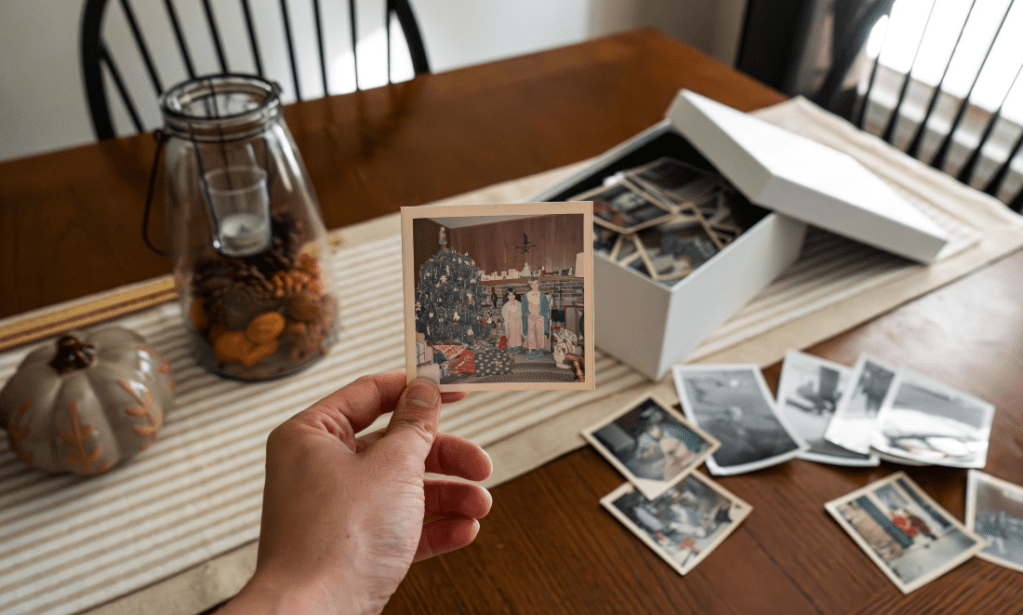
So here is my conceit: Every family, whether it knows it or not, contains both historians and guardians. The historian is drawn towards unanswered questions. They notice inconsistencies. They wonder why certain stories are told repeatedly while others seem to disappear altogether. They are fascinated by old photographs, forgotten letters, fading recordings and the curious silences that surround particular events. Historians are rarely satisfied with the official version of events because they suspect there is always another layer beneath the surface waiting to be uncovered. Indeed, some of my closest friends are history teachers and, believe me, they are seldom entirely satisfied with the provenance of their sources.
The guardian serves a different purpose. The guardian protects the family narrative, not necessarily out of dishonesty, but out of loyalty. They understand instinctively that families are held together by shared stories and that those stories perform an important function. They provide continuity. They explain who we are. They connect one generation to the next. Pull too hard at a single thread and the whole fabric can begin to unravel. For the guardian, preserving the story is often just as important as interrogating it.
Neither role is inherently virtuous and neither role is inherently flawed. The historian risks becoming detached, treating human lives as puzzles to be solved rather than experiences to be understood. The guardian risks mistaking familiarity for truth, defending stories long after their foundations have begun to crack. Yet conflict inevitably arises because each believes they are protecting something valuable. The historian believes they are protecting truth, whilst the guardian believes they are protecting meaning.
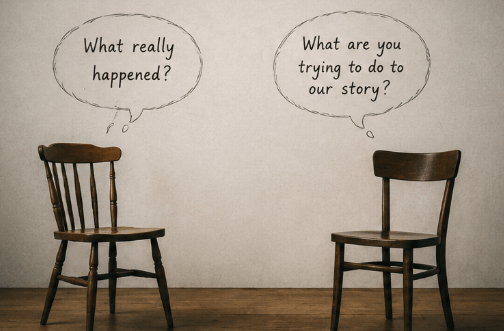
This, I suspect, explains why some of the most intense disagreements within families are not actually about the past itself but about who gets to interpret it. One person asks what appears to be a straightforward question: “But is that what really happened?” Another hears something entirely different: “The story you have lived with for years is about to be challenged.” One person believes they are conducting an investigation. The other believes they are defending a home. Both leave the conversation frustrated because they imagine they are arguing about evidence when, in reality, they are arguing about purpose.
The older I get, the more I think this distinction matters. History invites analysis. It welcomes scrutiny. Historians expect questions because questions are the mechanism through which understanding deepens. Memory behaves differently. Memory often invites resistance because memory is rarely just a collection of facts. It is entwined with identity. When we challenge a family memory, we are not simply reassessing an event from the past. We are potentially altering part of the framework through which somebody understands themselves.
Perhaps maturity lies in recognising that families need both historians and guardians. Without the guardians we lose the stories that bind us together and give shape to our shared identity. Without the historians we lose the ability to examine ourselves honestly and to understand how those stories came to be in the first place. The healthiest families are not those with perfect memories, but those with enough confidence in their love to allow those memories to be examined without feeling threatened by the outcome.
After all, if a story can survive only by avoiding questions, it may never have been as strong as we imagined. The families that endure are those willing to discover that truth and belonging are not opposing forces. The story may change. The meaning may deepen. Some cherished assumptions may fall away altogether. Yet what remains, if we are fortunate, is something more substantial than memory alone. What remains is understanding.
 StoatAubergine