Tag: parenting

  • Fathers? Absent. Teachers? Present.

    Fathers? Absent. Teachers? Present.

    The problem with holidays is one has time to scheme. The day-to-day pressures of working and upholding a work persona mean that when one’s time is one’s own and the inbox is ignored and the work persona shelved: new, interesting, ambitious and creative projects come to the fore. Currently, the ambitious and creative project hamster which spins the wheel in the back of my head and occasionally and loudly nibbles on toilet roll is what I would do for a PhD. More often than not, the rustlings and nibbling’s of project hamster are drowned out by the bellows of students and vicissitudes of everyday life. Like I say, that’s the problem with holidays.
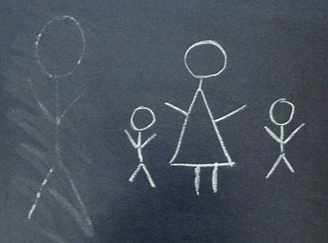
    Men are a problem. I would confidently claim that in a substantial amount of a child protection social worker’s case load the bulk of the load is caused by a man: a man who is absent causes problems; a man who is present causes problems. They’re just problematical. Problematic men in a child’s life within a child protection context would be fairly obvious – risk of abuse. However, their absence from a child’s life can place significant strain on the normative parenting workload of a single parent. Furthermore, the lack of a good role model can also be detrimental to a child’s sense of identity and esteem. However, not all male parenting figure’s absences are linked to child protection. Oftentimes, the nature of a significant male role model’s absence in a child’s life is simply due to expectations and pressures of work, and within the context of international schools – the earning divide. This is especially felt in countries where the wife (though not exclusively) or ‘accompanying spouse’ can’t get a work visa which places the ‘breadwinner’ burden firmly on the male side. The reality for a lot of hard-working and loving fathers is that their ‘problematic’ absence is not due to maleficence, but simply work commitment. Another significant variable, especially for expat families, is the lack of a family support network. All put simply, in my experience in international schools, dads are away a lot. I know this because the children tell me. And they tell me that whilst they understand why their dads are away…they miss them.

    Parenting can be problematic. And in child protection social work it can become unsafe and concerning. When child protection social workers are faced with overwhelming evidence that a child is at risk of significant harm, they can use legal powers or ‘Care Orders’ to remove that child from the home (often temporarily, sometimes permanently). During that period of separation and before any final court orders around adoption happen, the biological parents retain their legal status of ‘parent’ and all the responsibilities therein, however the local authority is given a new epithet: Corporate Parent. Now, I like the phrase ‘corporate parent’. That said, I understand the grind between something as innately caring and purposeful as ‘parent’ and something as myopic, calculative and materialistic as ‘corporate’. However, parenting can be a hot boiling mix of values, ethics and psychology that could benefit from the cubed iced drops of policy, procedure and measurable outcomes. What I liked most about the phrase ‘corporate parent’ during my time as a social worker is it separated me from the role. When I was working with a child, I could exhibit the unconditional regard for safety and the intuitive show of compassion and care linked inextricably with good parenting but had that corporate parent embossed tempered glass panel between us that allowed me to make rationale and evidenced based decisions for what was best – unfettered by any ‘loving obligation’.

    Well, that was theory. In practice it was incredibly hard – especially when the ‘Body Corporate Parent’ (senior leadership) insisted on decisions that either made no sense or clearly didn’t know the child. However, I digress.
    Can I say, the hamster in my head is feeling the love right now? I am metaphorically cleaning out the cage, refilling the water and putting a few treats in the bowl here. To be honest, it was beginning to smell a little bit.

    The PhD idea? I am essentially talking about non-dangerous absent fathers and the role of the corporate parent – in this case ‘teacher’ and more specifically: ‘male primary school teacher’. Where am I going with this within an international school context and what does this have to do with a PhD? It would be my view that male primary school teachers have a corporate parenting role to play in their student’s lives within certain specific contexts. I would almost go as far as an ‘obligation’ to do so (if I was feeling more controversial) And whilst there are professional, ethical, and sociological issues with this claim (and that I would be made to refute) ultimately, teachers do share the parenting load; they do have a legal duty of care anyways and, because of the problem of men – male teachers should be prepared to pick up the extra heavy lifting in certain contexts as a corporate parent.

    Cage is clean, hamster is happy. I’ve made a lot of claims here about fathers and family demographics in an international school setting – but I reckon with a good academic library, and some of my own qualitative research, I could substantively prove this to be the case. I’ll be arguing some pretty interesting points from education philosophy, sociology and ethics but again, I would probably enjoy that! But, what do you think? I would welcome the views of any readers of this piece on the statement:

    Male Primary School teachers have a corporate parenting role to play within the lives of children with absent fathers.


  • Pinky Cat: And her adventures through Food Avoidance.

    It happened at some point on the London Underground, Piccadilly Line, possibly as the train moved through Hounslow. It was the very final journey of our two-week visit to family and friends. The five of us had been burdened with 4 suitcases and numerous shoulder-slung, hand-held luggage as we moved between locations in both Essex and Yorkshire. We also carried another burden during our stay. The youngest member of our cohort had stopped eating solid food. In fact, she’d eaten her last morsel on June 17th. An elderly gentleman of possible South Asian descent remained expressionless on the morning of August 1st, as, sat across from us on the train, he witnessed an animated tableau of praise, clapping and whooping and the overwhelming relief felt by all. Maybe he never had children, and this was baffling; maybe this wasn’t the first time he’d seen a two-year-old eat a ginger biscuit. It was the first time in nearly two months I’d seen her chew. I nonchalantly watched her move the damp, heavily licked biscuit into her mouth – I held my breath, smile widening, trying to catch my wife’s eye. I witnessed our daughter bite the head off her biscuit (she is merciful like that) and chew. In that delicious second (for us all), we knew the seven weeks of patience, controlled emotions and bright, positive communication had actually worked.

    So, what was the cause, what was the diagnosis, what was the treatment and what, in a very Sesame Street way, did we all learn?

    First of all, some context. Aubrey was born with allergies. We didn’t learn of them until she was just under two months old. In October 2020, whilst we were living in Qatar, my wife had to return to work seven weeks after giving birth. She was obviously not thrilled with being parted so early from our daughter but, as they say in Texas, this wasn’t our first Rodeo, and so we viewed the early adaptation with stoical resignation. Fortunately, there was a marvelous nursery on the compound. To facilitate the move, we switched to mixed feeding and duly one morning, whilst my wife was getting ready for work, I gave Aubrey her first bottle of formula. Five minutes later our daughter had swelled. Her lips, yellow puckered and blistered; breathing raspy and difficult to catch. That awful aluminum taste in your mouth when you realize something unknown has wrestled the control of your child’s wellbeing from your own hands and placed it into a future unknown and terrifying. Our eldest son, who was thirteen, sprang into action, comforting our nine-year-old and maintaining a focus and calmness that fills me with admiration to this day. The ambulance was called, EpiPen administered, and after a year of tests she was proclaimed allergic to all dairy products and nuts. Aside from this, she is an all-round healthy little girl.

    With that in mind, we reckon the cause of her reversal from mastication stemmed from a soft ‘Haribo’ type jelly. We live in Uzbekistan, in its capital Tashkent. Here all product ingredients are presented in either Russian or Uzbek. We’ve become adept at checking ingredients via Google Translate, but small candy packaging can have font which requires less a phone and more a magnifying glass. She had a favourite brand of sweets with a white foam base and on that day, the day the eating ebbed away, I picked the same style of foam treat but a different brand. This brand had yoghurt in the foam base. I didn’t check the tiny writing and our daughter’s reaction, whilst not serious, was immediate and very uncomfortable for her. As the weeks went on, she requested smaller portions of rice, pasta and vegetables; pushed away from treats such as crisps and chocolate and on one evening rejected her rice milk. By the time term ended on June 23rd she would only ‘eat’ very smooth soup and the reason I have hyphenated ‘eat’ is because she wasn’t eating – she was only licking. Like a cat. In fact, over the period of her food avoidance she developed an alter-ego for herself…Pinky Cat. Pinky Cat liked to give food ‘kitty licks’ (patience-testing tiny whips of her tongue) and ‘kitty nibbles’ (fortitude- taxing introductions of food stuff to her teeth which she then mimed ‘nibbling’ and inevitably pushed away). All in all, ‘Pinky Cat’ was not popular but, as we learned at the end, wholly necessary.

    At least we knew the cause. The diagnosis? Well, here in Tashkent access to English speaking specialists like pediatrically trained dieticians is sparse. So, we turned to Dr Google and sure enough we were able to correlate her behaviour with the phrase ‘food aversion’. Clearly, her choking and coughing experience those weeks previous had had a profound effect on her frontal lobe and she decided that no more solid food would be invading her esophagus for the foreseeable and like an exclusive nightclub she put up the velvet rope to her pallet with an instruction which read ‘Sorry lads, if I have to chew you – you’re not coming in’

    The treatment? Well, this was simply the most challenging part: Patience. Now, we had a few things in our favour. First of all, we are both teachers and were on summer break. We had time on our hands to make a plan. Secondly, irrespective of her decision – she was absolutely fine. Her decision to accept only rice milk and slowly and deliberately lick up soup as ‘Pinky-Cat’  had no impact on her energy, demeanor, sleep or personality.

    This was our rational anchor.

    Between the weeks at home under the hot Uzbek sun and the classic fortnight of a changeable British summer, the four of us kept each other’s ‘cool’. We applauded any brave step towards sustenance more robust. We blended, we cajoled, we sieved, and we sneaked in different food experiences. What we learned was that she needed time to process her fear. We literally started from scratch – weaning her back to solid food. The silver lining was that she made a firm cognitive step. A new schema had developed (to borrow from Piaget). As we boarded the plane back to Tashkent, we were able to help her understand that some food had ‘cow’s milk’ and she couldn’t eat it, but most foods would do her no harm. In tandem with her own cognitive development, we re-constructed her understanding of her own diet. Now, our daughter is able to rationalise (as much as a three-year old can) what is good for her and what she needs to avoid.

    “No pizza daddy! Pizza has cow’s milk!”

    And yes, Pinky Cat still makes an appearance now and then. This time as an endearing way to catch a snuggle. And no, we don’t feed her from a saucer.

  • TikTok, Neo-Pronouns and The Construct of Reality.

    Warning!

    This blog will contain a middle-aged man talking about TikTok.

    Yes! This blog is going to involve TikTok, okay! I can talk about TikTok and not have to reverse a baseball cap, cross my arms and summon an ice-cold phrase like “your cappin, bruh”.

    Stay. Don’t go. That first paragraph may only have been funny in my head.

    This month’s blog is a blend of philosophy, sociology and how both those disciplines informed a parenting opportunity to explain a few more ‘whys’ about the world. 

    If you have teenagers, live with teenagers, or teenagers play a role in your life – it’s good to project a presence in their sphere of influence before they wipe you out completely with one swish of their finger. Fortunately for us, our eldest is still happy to include us (selectively) in his world and it is not uncommon for him to emerge from his bedroom and come downstairs to talk about the latest TikTok encounter that has left him perplexed. Before I get into this – can I just state that I like TikTok (which, given my demographic, has just dropped its share price by 80%). But I do! What I really like is that it does provoke debate. For our eldest (let’s call him ‘Number One) TikTok represents a portal into the wider, more complex world, the world that we ‘parent-bots’ are obligated to prepare him for. So, let’s take this opportunity to dig deep, unpick and hopefully enlighten. 

    “Come back Number One, and unroll your eyes from the back of your head…this might be interesting”

    A topic that has yet to fully shake itself into some semblance of order, and one that has irked him for longer than previous videos is the subject of ‘neo-pronouns’.

    Neo-Pronouns or ‘new’ pronouns are an extension of the established singular personal pronouns such as ‘he and she’. ‘He and She’ refer to the establish binary genders of male and female.  However, for persons who don’t identify with either male or female binary constructs, (persons referred to as ‘non binary’) ‘neo-pronouns’ offer an alternative ident crucial to their well-being and sense of self. For more insight on what these neo-pronouns look like, check out the link below:

    https://www.unf.edu/lgbtqcenter/Pronouns.aspx

    Number One had no problem with this, his problem was with some of the more bizarre neo-pronoun epithets being requested via TikTok such as rabbit, pussy-cat and kitkins but I could see that the bigger question was how established truths taught in school and reinforced by social interactions (like boys are ‘he’ and girls are ‘she’) could suddenly be so questionable. What other established truths could be unmasked? Was anything real?

    Well, Number One, there’s a handful of threads there we just don’t have time to pull on right now. However, there’s a sociological perspective which might offer an insight into how it can be that whilst it’s obvious what men and women ‘are’ – we can still say that there’s a fluidity in their meaning. 

    It’s about a sociological perspective called ‘social constructionism’ and its daft Uncle ‘Post-Modernism’ and rational Aunt, ‘Epistemology’. I don’t know if the whole family analogy’s gonna work here – so let’s stick to Social Constructionism and put the ‘Uncle, Aunt’ and the history lesson back in the box.

    Social Constructionism rejects ‘meta-truths’ such as pink is for girls, blue for boys  and gender is objective based upon the observable and universal truth that girl babies are born with vaginas’ and boy babies have penises. Put as simply as possible: social constructionism is the perspective that our reality (as we know it) is socially constructed – put together by ourselves and others both from our personal sphere (family, school, church) and the larger spheres (government, media) that form our society.  It’s not a clandestine, Rothschild operation! It’s a sociological perspective based upon previous philosophical concepts and good old fashioned research. It means that how we understand the reality we daily experience is based upon not only our own subjective experience of the world (what we ourselves touch, taste, see and hear) but the sharing of ‘consensual truths’ (that we all agree the grass is green) and shared semantic truths (how we name things and what those names mean). So we have blend of what we think is so, and what we all fundamentally agree is so.

    We must be wary, however, that possibly all semantic truths (taught definitions of things) were given to us by other folks who themselves – constructed those truths. For example – if you want to be a successful fashion model you will need to be thin. Why? Because the people that dominate the modelling industry in recent modern history have claimed the language and the construct of what modelling is. Therefore,  if I told you to think of a catwalk model – your mind may picture a tall, thin woman.

    We should accept that social constructionism is a solid enough theory to give it some attention. It has been of tremendous use in challenging prejudice, racism and sexism – questioning authority and demanding deep dives into the  semantics, cultural norms and traditional values  which rule our society  and dominate the interactions within our personal and collective lives.

    Men and Women both have different reproductive organs, given different names – names we all agree on. But if we were to transplant the male reproductive organ directly onto a woman – would that automatically make her a man? It intuitively doesn’t feel like the reproductive organ does enough to confer gender. It should do because a man has a penis and we all know its called a penis and all agree to what it does and where it is – so that’s enough for a human to be a man, right? The answer of course is that our sexuality and our gender identity is not simply the clump of cell, skin and muscle that make our private parts. We know there are a constellation of  psychological, mental, emotional, environmental and cultural stars, creating and defining our sexual and gender identity. And each of those stars are prone to change and are constructed socially, and because they’ve been constructed socially, there’s a chance their semantic construct (what they are named) and the shared ‘truths’ about them (what we all agree on to be so) has been created by powerful persons in the past.

    For example, when the powerful maxim that men are the breadwinners and women stayed at home to raise children became societally fixed – there was a consensus on its truth. A truth buoyed by biologists (only women can have babies) evolution theory (men are genetically programmed to hunt and provide) and religious doctrine (Adam the first human in the image of God – man as head of household) and ta-hah…the labor preferences (where each gender’s contribution to society is best served) between men and women became as pronounced and as set as the physiological one and in fact; became an essential component.

    But that labor difference of a man and woman’s place in society is not an objective biological truth. It isn’t so that having a vagina and a physical ability to lactate means you stay and raise children. Of course women can have babies, raise a family and work full time and of course men can have babies (adoption ) raise a family and work full time – so the physiological differences are not necessary upon what each gender can do in their family and their societal roles. What made us believe it to be this way? Those who dominate the agenda – dominate the language. As a nice analogy, let’s have Meryl Streep explain it to us:

    But even the concrete assertion that our genitalia confirm objective gender can be questioned. Consider the rare condition of ‘ambigious genitilia’. For this condition neither sex is clearly present. The social constructionist has no problems here as they know that gender is socially constructed therefore the person growing and developing with this condition will be defined as more than what the condition delineates for the confused biologist. For whilst the pervasive and powerful elements of society will label and construct meanings for the child, the child as they grow into a more sentient and rational adult will also have (hopefully) the power to construct their own meanings and ways of being. For the objective realist – the lack of certainty of a condition such as ‘ambigious genitillia’ will mean them putting a reluctant foot into a world which questions the kind of grand truths the objective realist swears by every day.  

    However, this is where I should stop pitting the two sides against each other and to pull back from an ivory tower over-view effect. In the real world, of course we accept that some things appear universally real and agreeing on that is important and equally some are up for debate, whether morally or in terms of their existence. We need to consent on shared knowledge, but we also need to recognize that not all truths are universal. And this is key to social justice campaigns such as gender equality. If some narrow view of evolutionary bioethics is to be believed than men were meant to be hunter gathers and women child bearers and homemakers. Social constructionism saved us from such a myopic and limiting view of the role of the two sexes and now we push back against any suggestion that there should be set gender roles based upon physiognomy. What happened next when it comes to LGBQT and transgender is the next stage in our progress in better communicating and understanding each other’s differences. 

    Conclusion:

    This isn’t a blow by blow account of my conversation with Number One son! I introduced him to how it is possible that seemingly irrational things can exist. Of course men can have babies for what is a man? Of course we can jump to the moon if we employ logical possibilities instead of physical possiblities. Billions of humans all over the globe put their decision-making processes and moral responsibilities into the hands of a divine being that cannot be objectively seen or measured. – and for those rationale theists, there’s nothing confusing about that at all. The purpose of it all is about how we wish to be seen and wish to be heard – flexing our freedom of thought and our sacred individuality. If a TikTokker is laying out their neo-pronoun stance because that is how they wish to be seen and that is how they wish to be heard then there is no harm in that.

    But running that freedom of thought and expression, powering that ability to question established truths and co-construct new ideas is the engine of social constructionism. It is not a perfect engine – but it has been a charioteer of change which whilst discomforting for some individuals; social constructionism drives, somewhat ironically, individuality itself. 

  • How our ‘Parenting Values’ could be a barrier to good advice.

    This month, instead of a piece heavy on analytical philosophy, I want to present a discussion. I’ve been meaning to put some thoughts down about parenting and with the half term holidays now upon us – it felt like the perfect time to write such a piece. Spoiler alert: whilst I am deliberately toning down the philosophy – there may be a smattering of psychology. 

    This was one of the best pieces of advice we were given as freshly minted parents:

    The bad times will always pass, but so will the good.

    At first blush, this can seem a little disheartening, a little discomforting. Our initial reaction was one of: ‘Wow..okay..errr..thanks?’ However, it came to be a wise and oft repeated mantra as we early parented our eldest into his nursery years. The same with our second, and now it’s as prescient as ever as our daughter moves into her next phase of weaning and sleeping through the night.

    What the phrase means is: don’t drop your chin when the tough times of caring for an infant kick in, because it will pass. Equally, don’t get complacent when it’s all gurgles and giggles, smiles and naps. Philosophically, this is all very stoical (I know, I promised, but it’s just this bit). Be in the moment! Take nothing for granted. This is a practical way of thinking about parenting, a way of rationalizing your emotions.

    Practical parenting advice can give you small victories as well as promote healthy child development. When they were babies, I always found gently tapping our children’s backs (mimicking the mother’s heartbeat in the womb) a useful way of calming them when they’d got themselves into a tizzy. This was shown to me by our Health Visitor at the time (what troopers they are – In the UK a Health Visitor is assigned to every new mother and father to support with keeping their baby healthy and happy as well as performing some clinical work and yes, it’s free of charge). Then there’s using distraction techniques for toddlers (who were misbehaving) to avoid public (mainly supermarket) confrontations. Then there’s helping your teenage son negotiate Xbox time so he keeps on top of his studies. All of these things I do have been techniques taught to me and none of them have asked questions or changed my values as a parent. 

    I wonder though if that’s the comparative beauty of practical parenting tips: their overall objectivity. If it can be applied to your own child and if it works, hurrah! And if it doesn’t? No harm, no foul. Practical parenting advice can be simply about how your ‘doing’ something (for example: tips on effectively releasing trapped wind). Or it can be about cognition (how we think about a problem) for example: how do I promote my teenage son’s privacy whilst also ensuring they are safe online. But ultimately, practical parenting advice be it ‘doing’ or ‘thinking’ about how to improve some quality of our child’s life is about encouraging our approach to be rational and see outcomes as measurable. 

    I should also make a clear distinction between ‘parenting advice’ and clinical and legal requirements in law that inform how to treat children and keep them flourishing. But as I shall sketch later; parenting values can sometimes cross that line as well. 

    Not all parenting advice is practical. Some of it can question our ‘ways’ of parenting – it questions our entire parenting philosophy – our parenting values. As a child protection Social Worker – operating at the thin end of this wedge – I would see practical parenting choices informed by strongly held beliefs that were potentially causing emotional harm to a child. My professional guidance here was more than just helping parents make better practical parenting choices – it was about overhauling a whole parenting approach for the good of the child. I want to try and avoid over seasoning this discussion with serious tales from social work. I mentioned it simply to state that freedom to parent according to our own beliefs is not always permissible.  

    Here is the important distinction I want to make: a parenting philosophy can inform the choices we make as to how to practically parent (either what we do or how we choose to think about parenting). Examples might be parenting according to religious beliefs, cultural norms or subjective ethical choices. My discussion in this post is about this part of our parenting life. We can pick and choose and be less emotionally attached to practical parenting advice in itself – but when it comes to advice that pulls at our parenting values…we can be less rationale.  

    We need an example to flesh this out a little. One of my parenting values is I want my children to be independent. I remember when my eldest was five or six and falling off his bike on a busy Sunday afternoon at the park. This was not his first ‘rodeo’ (as they say in Texas) and whilst he had ridden before – he was still a relative novice. As he lost his balance and tumbled into a heap of bike frame, spinning wheels and scraped knees, I made a quick visual assessment of his wellbeing: he was fine.  Therefore, according to my values, this was an opportunity for him to self-regulate and self soothe. A chance for him to practice differentiating between what he can make better himself versus what I as his father should make better for him. And so, with a steady strong voice I told him to ‘pick himself up’ ‘dust himself off’ and ‘get back on’. I remember vividly the disapproving looks I got from passers-by around me. I think the expectation was I would rush over and scoop him up and ‘wipe away his tears’. But that isn’t part of my parenting values. Later on that day my son and I chatted about it and he was able to understand how ‘being brave’ and ‘getting back on the bike’ were virtuous actions and I knew that this reflection and internalization would serve him well in his development. 

    I know cognitively and rationally that self-soothing and self-regulation are critical in child development for well-rounded secure children. But I chose to follow that guidance because as a child growing up with a parent with severe mental health problems, I have internalized a suspicion of being overly dependent on others. So you see, my values come from a deep emotional connection. And that has informed my practical choices. 

    All that said…there’s nothing wrong with a parent running to their disheveled and wet-faced five-year-old, kissing their grazed knee and buying them an ice-cream to make them feel better. It’s just…that’s not my way of parenting. If a stranger approached me displaying disapproval with my outlook and sought to advise me against it…it may not be met by my rationale brain! But why?

    Our ‘way’ of parenting can be influenced by so many factors. As I confessed to above, our own experiences as a child would certainly act as one of the main sources of values alongside the values of our own parents. One explanation for this is: ‘Social Learning Theory’. In this theory, children are more likely to copy ‘models’ identified as ‘high prestige’ particularly when the action being copied is rewarded in some way. By ‘models’ we can mean not only significant adults, but even celebrities and personal heroes in the media. This ‘copying’ and internalizing, formed by social interactions, big and small and both inter-personal and through the media builds the mountain strata of our own parenting personality. These compressed layers  of our social interactions, each different in density depending on the attachment (family, friends, societal norms) sees us settle into a ‘way of parenting’ that structures a philosophy and approach that informs some of our practical parenting choices.  In my experience of working with parents both as a teacher and social worker these values, whilst not as immobile as a mountain, offer some resistance when challenged even when the challenge comes from a place of good reason. 

    Let’s take an extreme example to secure my point on this perspective, smacking. As practical parenting advice goes: don’t smack your children. There’s no evidence that it is beneficial. Most children who are smacked will still do the thing they were hit for doing in the first place. Aside from its questionable efficacy, the other issue with smacking is it doesn’t come from a rational place. As a Social Worker I met families who smacked their children and the conversations never went like this:

    Thanks for coming Dillon. Billy bit her little sister yesterday. So his mum and I…we sat down and we discussed what we should do about it. We decided that a good smack on the bottom should just about do it. We tried to find a smacking ‘app’ but sadly nothing, so instead we agreed on where on his body the smack would happen, the force of which it would be delivered, and the post-smack discussion.

    Said NO-ONe, ever.

    The reason this doesn’t happen is because smacking is not a rational act; it’s an emotional act. 

    Therefore, what could be the rationale, the sensible reason,  for hitting a child? 

    The response?

    “It never did me any harm”

    In America hitting your child is sanctioned (it’s defined as ‘reasonable chastisement’) and also in the Middle East. But it’s still up to the parents whether they want to add striking their child into their parenting toolbox. However, because it’s not the rational choice, it must come from somewhere deeper, somewhere where knowledge is acquired through a socially learned way of being rather than a place more objective. I would certainly argue then, that a right and just time to challenge a ‘way of parenting’ even when it may not be causing significant physical or emotionally harm – is when that parenting philosophy is mirroring or copying learned behaviors that are in themselves either fault or crumble under the scrutiny of good parenting practices for child development.  

    Therefore, my discussion here is simply this. Clearly, there is sound objective (and often clinical) practical parenting advice as to what is best for your child. Then there is advice that promotes healthy ways to ‘think’ about parenting and the challenges that come up. However, our parenting values, the way we wish to parent will inform which advice we take. And if there is a ‘faulty’ value in there, this could lead to good advice being ignored and sketchy guidance being adopted. 

    Conclusion:

    So, what’s the solution? Well, for some children, parenting is not done by one person. I have met many, many hard working and dedicated single parents. My goodness me. When you have been in the company of a single mum with the three children under the age of five – you cannot help but be moved to admiration at times. For those fortunate single parents and parent duos there are own parents (or significant others), grandparents and a posse of friends, aunties and uncles who can keep ‘us’ within the checks and balances of rationale parenting. I am very fortunate. My wife and I share the same parenting values and so we make a good team. When I am being irrational in some parenting approach, she’s there to re-ask the motivation behind a decision and vice versa. Just a few weeks ago I was cross at my son and so took his xbox out of his room. But that doesn’t promote his ‘self-regulation’. It only edifies the controlling parent choosing punishment over restoration. I gave it back to him the following morning and apologised – and the resulting conversation laid firmer foundations on which to build each others expectations. I also firmly believe in the old proverb – ‘it takes a village to raise a child’. If we can accept our vulnerability as parents and the unpredictability of raising children, we will find ourselves receptive to not just helpful parenting guidance, but also checking and reflecting on our own values and make sure they come from a place that results in choosing advice and help that is truly best for our child. 

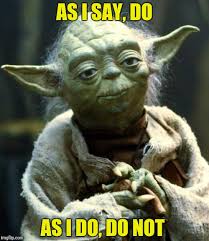
  • Do as I say, not as I do: A reminder that being our best selves should be a goal, not an expectation.

    ‘Do as I say, not as I do’ is one of those phrases that, from the heart, can illuminate and provide insight and wisdom. I love its appeal as a prologue to the sagacity and experience of the utterer. Whomever speaks these words is by admission opening themselves up to a conversation about their own personality flaw or where they’d gone wrong in the past. However, it can be construed as hypocritical and dismissive, authoritarian and contradictory and this can blight the authentic power of this phrase – because spoken well it can, like a spell, alter pathways and outcomes into a much better place for those who hear it. 

    The phrase could be the motto for the any person who tacitly or experientially understands why a decision or way of acting might have bad consequences for someone else in a similar situation. Still, when I reflect a little deeper, it’s a phrase that promotes that most frustrating nature of our humanity – the person I am in my mind is still better than the person I am in the moment. “Do as I say” (for the person I was back then was right) “Not as I do” (for the person I am now is still flawed)

    Today I want to talk about this phrase used at its best; spoken by the person with good intent.

    “Do as I say, not as I do” I will argue is another example of how our imagined selves are always so much better than our clumsy, thoughtless, awkward real selves and there’s some ancient philosophy at work which might shed some light on why that’s the case. This phrase, at its best, establishes that none of us are perfect and all are vulnerable to error and that where we have experienced perfection in some action in the past, our realisation of how well it went often only comes after the event, where reflection provides the building blocks to construct another positive component or facet of our ideal self. 

    Let’s have an example. In fact, I will use the last time I uttered the incantation. As a teacher, particularly of adolescent students, it can be difficult to methodically and in stark detail explain to them why their actions (or lack of action) may be drawing the ire and frustration of another teacher. You don’t want to dive too deep into the complexity of adult human interaction with a fourteen-year-old and equally you don’t want to speak with too much familiarity about the idiosyncrasies of a colleague. It last occurred in a conversation with an embattled Middle Schooler who seemed to consistently run into trouble with a particular teacher.  I was recalling to this 8th Grader how ‘when I was his age’ (cringe) I had a similar combative relationship with one of my teachers. But I wanted the 8th grader to know that my own feelings of frustration at the time with that teacher all those years ago were justified (and still smart *insert undisclosed number of years* later) but rather than act mindfully I acted on emotion and dug myself a deeper hole which ultimately hung a label round my neck which followed me into High School. Returning to this current conversation, I knew there would be sway within the empathy of ‘I know what you’re going through’ in my chat with the student but what I can’t disclose to this young man is that there’s a power imbalance in the teacher’s favour at play that is too great to overcome and that there was a way to play’the game which would not only ameliorate the situation but could offer a life skill moment for future encounters. At which point I am left with no option but to tell him straight what to do and hope my own story of woe resonates and thereby complete the ritual of ‘Do as I say, not as I do”

    But it’s not technically ‘Do as I say, not as I do’ is it? It’s ‘Do as I say, not as I did’. However, I can rectify that by saying, with a degree of confidence and the backing of plenty witnesses (mostly long-suffering friends and a weary, smiling wife) that I still let my emotions rule the moment. I still allow overwhelming feelings of injustice put me in fight mode when oft times ‘flight’ is the more sensible course of action. So, the perfect ‘Dillon’ (rationale, thoughtful, wise) is usurped by the actual ‘imperfect’ Dillon (impatient, passionate, headstrong).

    So now we have a concrete example of the contradictory nature of the phrase. Often, acting with pure emotion in a heated scenario can lead to a worsening of the situation. Keep a level head and act rationally and not, as I do, which is more often than not reply “Oh! You think that do you? Well, let me tell ya….”

    Reflecting on past successes add to our internal rendering of our own ‘ideal form’ or ‘ideal self’. The Greek philosopher Plato believed in ‘the forms’. He held that there exists the perfect form of what we consider to be abstract entities. Perfect form of justice, perfect form of courage etc. Let me put it this way; you and I can disagree on whether a painting in a gallery is truly beautiful, each holding a subjective opinion as to what counts as beauty. However, we both agree that there is such a thing as ‘beauty’. Furthermore, for Plato there really does exist the ‘perfect form’ of beauty which we as humans can never actually experience but the sense of which is somehow imprinted into our minds at birth (and the whole metaphysic of that claim is for another day).

    I think that such a concept of ‘perfect form of self’ is also within us and like Plato’s forms is unattainable. Instead it is such a thing as we strive too be. Examples of falling short might be coming up with the witty call back hours after a difficult and flawed encounter – or being able to better recall facts to win an argument after the moment has passed. We are always so much smarter, faster and better after the event. 

    Like the perfect forms such as ‘beauty’ and ‘courage’ we can accept objectively there’s such a thing as an ‘ideal self’. Then we act as the subjective architect and construction engineer of our own ‘ideal self’ (just as we accept there’s an objective form of ‘beauty’ and begin to construct our own tastes that reflect that ideal form). This is done through experiences of societal and cultural influences, the good and bad, the ups and downs giving us the data to create  an imprint of our  ideal selves (based on an objective concept of such a thing) which should inform us as to the best way to act. But like so much about the world we perceive – our ideal self can become kaleidoscopic and illusory. We lose sight of the ideal self as being a template and aspirational and look for different ‘ideal selves’ or even believe the ideal self is expected. ‘Ideal Parent’ ‘Ideal Work Colleague’ Ideal Student’ How could we ever consistently be so many different things to different people? And more worryingly, why should we always expect to be…perfect?

    ‘Do as I say, not as I do’ is probably the coda that breaks that ineffable goal, and rightly so.  When the content of our advice or guidance is  packaged clearly and authentically with this phrase and delivered with humility it can, to some degree, also reinforce the most human trait we all possess…that none of us are perfect and where we have had success it is from the guidance of others and limned with our past failures. If we accept Plato’s idea of an ‘ideal form’ of self then we must also accept that we will never truly know that ideal form and that’s okay for it’s meant to be a template to draw our identity on not a puzzle to complete. ‘Do as I say, not as I do’ says: we still fall on our faces – it just doesn’t have to hurt as much is all.